Showing posts with label fiction writing. Show all posts

Wednesday, December 31, 2014

2015 Plans!

Just to end the suspense, yes I did win Nanowrimo 2014 with a no-name bad fan fiction based on my Piarra fiction, which All Needs Massive Editing. I have edits on the first book, Chazho, in progress from last April but need to pick that up again and redo from the redo. Actually read back through the redo and reverse one change, then keep going on it minus that change. If I made my character black, the human characters in America would react to him differently and the book's ending would not work. All history wolud be altered. He has to be and look like an alien version of a typical white bearded young geek Silicon Valley type of dudebro, slightly bewildered by sudden success but still Very Stereotypey.

Greater consciousness can come later in series and will.

Big sudden change of plans though. The Piarra Series is a huge rewrite project and one I do not want to release until at least the first five important books are revised and ready for publication. Most of the rest are sort of fun but not integral to the backstory of the whole, but those five are the events that entire backstory hangs on - with many time travel novels intersecting them. 

So when they go to print, they need to be perfect. They will become canon and anything I don't like in them is "history and fact" as the time travel emperor says when he nails something in as unchangeable, work around it.

What's big is that I am also preparing to release a stand alone book, Elder's Pride, in 2015. I was lucky enough to get Jillian Lambert for my cover artist. I've loved her work for years and years, especially her graphic novel Brainsick. I followed Brainsick through many iterations and finally beta read the final version. Adore the story. Then in chatting in general looking at her current projects, we got to talking and she got interested in Elder's Pride.

So I sent her the rough draft. I've already had a good critique on it from Nonny and one little thing from that critique and others stuck in mind - the prose style of the science passages was imitation Robert Bakker. It fell flat because that isn't my voice. I am not an actual paleontologist or a professor used to doing lectures on evolution. I'm a science fiction writer who handwaves on the science all the time, loves science but likes to make it all up to have a free hand with backstory instead of being nailed to unpleasantly limiting reality. 

So in one of the emails to Jill, it clicked as I tried to explain to her what I'd rather do than fake Bakker-voice. Fake Bradbury voice. Poetic, my real sense of wonder about the history of life and story of evolution, not a scientist's voice at all but a science-loving poet's. Not even imitation Bradbury so much as borrow a couple of his techniques of prose poetry and convey a sense of wonder that these cats are related to my cats and the lineage of all cats is a great beauty in the universe. The book is a cat lovers' novel. 

If you like cats and big cats, you'll enjoy Elder's Pride because the story is about a family of cats forming and migrating to a new territory, settling down there, fighting off rivals and having kittens. There are no humans in it. Humans haven't arrived yet. This is in the long prehistory before any of those people in canoes showed up to carve out their territory among the short faced bears, long tooth cats and American lions who were apparently a whole lot like African lions but just lived on our continent then. MGM was on to something!

It's all about the cats. I did it for a Nanowrimo but I researched it for several years before I did, both online and offline. I miss all my big cats and sabercats reference books, they're still in Arkansas. Fortunately though, all this book really needs is some attention to Point of View to keep it oriented for readers and my replacing all the dry science with poetic richness - and poetic conciseness, that happens too when poetry's applied. 

And Jill, who is a very good realist artist as well as graphic novel artist, is going about it a lot like James Gurney, making plans to do a maquette of one of the cats to draw from. This is going to be so beautiful. Heck, I may draw the cats again too in order to keep myself focused on the edits. But the author sketches are for the website of the book, the cover goes to Ms. Lambert. This is going to be awesome!

It is the beginning of the dam break. I have way over 50 novels stashed in my hard drive that need editing and prep. As I start shoveling them into availability the proceeds will go toward the next books in line, until I've got them all out somewhere earning. Only when I've got through the most salable 20 or so will I even start getting down to "maybe this is a toss rather than a rewrite" category. Most are pretty salable. 

Glad to be starting with "cats." I might return to them in November 2015 too, either big wild cats or small ones.

Tuesday, November 25, 2014

Nanowrimo 2014

Oh boy. It's been two years since I updated this blog and it's a good one. Just to catch you up, I had some financial issues that led to some health issues and logistic problems. I live in San Francisco on a limited SSI income in an SRO - Single Room Occupancy residence hotel. I love this place and the rent is affordable. It's tight though, so rising food costs and other expenses ground me down and I had serious trouble eating till I got onto a hot meals program from the local Salvation Army. Five days a week, minus holidays, I get a good organic hot lunch from them and that closed the gap.

I also used to see a therapist every week on Mondays. From going out maybe once or twice a year in harsher climates, I went up to six times a month on necessary medical appointments with others thrown in as needed - usually by bureaucrats or doctor's demand. In my first six months I had to go to many more because of various things I was doing. I wore myself down. IT takes years to completely deplete my body energy but when I'm living on a cumulative net loss and overexerting myself, it will eventually catch up with me. I wound up shutting down more and more aspects of my life because I didn't have the energy for it. I slept like my cat.

Part of that was a change of therapist. My first one did me a lot of good and helped me like a case manager. Julie even hooked me up with the food program. However, the second one, a good therapist, relied much more on methods that don't work well with my physical disabilities. I gave it a good long try and we explored every possible solution within his skills but had to quit.

The program changed its rules so that long term therapy wasn't supported so we couldn't go on with the method that does work. Talk therapy unraveling past traumas with full understanding of their causes and scars helps and always seems to point to the same thing.

Either my physical disabilities, especially when untreated and undiagnosed, distorted my relationships or the necessary adaptations I made to be able to function at all made me very hard to live with. Many things most people enjoy are difficult or impossible. I limp to a different drummer. I'm not a loner by personality. I'm a sociable, gregarious person who enjoys being around people in any positive situation, but only when I'm physically up to socializing.

In person past a certain level of pain or loss of energy, I'm not fun to be around. I get foggy and confused. Fibromyalgia can reduce me to unintelligible so fast if I get an emotional shock. I had to give up debate in person and eventually altogether.

Now I post my views online just to air them and don't read the discussion that comes after unless some positive comment gets to my inbox. I will be one of those authors who has to pre-filter his reviews or just not read them because it's not worth getting sick over it when my book isn't to someone's eloquently expressed taste.

Crowds are right out of it. I literally can't keep up moving with the crowd. I'm not afraid if I'm up on the podium doing public speaking, because they're not running right at me. I can open up there at my pace and get entertaining. But I will not be in time if I try to sing with a chorus or be able to stay on my feet throughout the song.

I can't live on the clock. I thought I could live on the calendar but if I get sick, a long slow recovery time knocks me off that. I thought I could do deadlines. The only way that works is if I'm already done and that's just a matter of when to release it. There is no way my body will allow me to behave in a professional manner. I am not and never will be business class.

That doesn't mean I won't write or publish. It means that has to come on my schedule and I live on Indian time. It's done when it's done. When it hits print it's done and there will be no more changes unless I decide for my own reasons to make some years later.

Raven Dance is slated for a tightening rewrite, an afterword about real life inspiration and most of all the natural break into two volumes that comes when the timeline has about a year gap from the end of the previous chapter to start of the next. I just sailed into the sequel without realizing it was another book and the structures are complete. If all I did was come up with a book one title and break it, that's the kind of change that can work.

All the rest, old or new, are still unpublished and thus Not Done. I'm working on a rewrite of Chazho, which is book one of my Piarra series. It has a mountain of backstory and over thirty other volumes in that setting.

I still participate in Nanowrimo and I won again this year. For several years I've been doing stand alone books for Nanowrimo with an eye to more varied fare for readers when I start releasing all of them. I still love those, especially Sabertooth. They're cooling for rewrite and what I need to for a successful career is hone my editng process till it's as smooth and familiar as my drafting process.

One problem with this is San Francisco weather. November is one of my worst months here. The start of winter gets rainy and cold. Not snow like the rest of the culture but a bone-aching chill that sucks down my energy into pain and kicks fibromyalgia up into a huge continual flare at every pressure change. I sleep like my cat and can't concentrate in November.

So what I did last year was try a difficult genre I'd never done before - steampunk. I like Victoriana. I like some steampunk novels. The clothes and stuff are cool. I cannot figure out what I don't like about it since it's a style that lends itself to Dickens Revival! I could even tackle economic issues in it well, focusing on the echoes of the Gilded Age in our times. Yet I didn't exactly do that and the book barely got to 50k. I'm not sure if I even wrote the ending or halted in exhaustion on making it past the winner line. It needs more work and hard work to get it right.

This year I thought "Hey, why not Horror?" Wonderful title: Fear This. I picked a classic subject, Serial Killers and then my protagonist became a wonderful antihero who's basically a traditional Female Serial Killer: Vigilante... then the supernatural came in. Whoohoo! Awesome, it's genuinely going to surprise readers, it's myth gone wild, it's true to source as I can get it but breaks some ugly stereotypes. It's a good book.

I also had three to five day gaps between scenes or chapters staying on track. I got to 21,210 at a point I was supposed to be getting close to 30,000 and the freeze set in. I wasn't going to make the numbers on Fear This. 

NaNoWriMo was a cakewalk most years. I've done Three Day Novel Contest officially three times and unofficially most years. I've written a 75,000 word Three Day Novel, a comedy with kids and bed monsters, that came out as a good stand alone book. That's my natural process and speed.

When I tackle a difficult subject during bad weather the result isn't guaranteed. So I realized I should just take Wrimo for what it is and write a bad book that could give me some good ideas or a workable rough draft. I dropped all the pressure that was choking me on Fear This and titled my goof-off project Pure Self Indulgent Tripe just to remind myself what Nanowrimo is for.

You don't get a good book on the first draft. You get a first draft that can become a good book once you polish it and throw out what isn't needed - in my case, sometimes that's one in three sentences to cut it to size. I write like an Impressionist painter. Get an idea, then throw it out there into a file working fast and intuitive. Try to get it down really fast while the idea is hot. Tell the story to myself first and then see how it looks when it's done.

From the first chapter's goofy reminiscing in first person to the second chapter introduction of a character from the old series - or rather from its backstory, he wasn't who he said he was - I was back on Piarra with my Byzantine royal intrigues, complex multi level plots, character driven stories and huge cast. Not all of them got on stage. Enough of them did that I now have a good idea what the characters are actually doing now rather than what they were doing in 2000 on and around Contact Earth.

Whether I retitle, rewrite and publish Tripe as its own book isn't relevant. I could easily treat the whole thing as a character study and world building exercise to get a better look at my series as a whole. But I won Nanowrimo a couple of days ago doing it and that brought back my mojo.

I have to have fun. I can't work on it like I'm trying to do a commission of something I'm not very good at yet. I can let the wordstream flow if I'm sick but only if I am so engaged in the story that I'm lost in it feeling the endorphins of process. If it's hard work, it may come out well but it has to be done more like photorealism - carefully look at this story and pick it out, get it precise, get almost perfectionist about its details to make it work.

That's not a reason not to do it. It's a reason not to do it for Nanowrimo. Wrimo is supposed to be a break, an annual vacation of the mind. Lose myself in a good book by one of my favorite authors, me. I like horror but my daughter brought up something telling about Horror and Fibromyalgia.

"Dad, if you scare yourself you're going to flare and get sick."

Duh. She made sense. So the Horror novel is now a slow back burner project. I might even outline it because writing it was so much less intuitive. It came out just as well outlining as "pantsing" so that may help me complete it. Get the gist of the plot down while I still know it, so I can pick it up later. Sketch and trust the sketch to be reasonably well balanced.

In art, sometimes I just sketch fast and layer color and work before the light changes in pastels. Sometimes I measure carefully and sketch in erasable colored pencils and do a watercolor underpainting neatly setting under layers to each area of tone and color, then layer Prismacolors 20 to 30 times to get a rich glowing realism painting achievable in no other medium. They are different processes, one fast and one slow. If I look at difficult books that way and difficult genres that way, I may succeed in those ambitious projects.

Just as long as there is no deadline for their completion, I'm good.

If you're doing Nanowrimo, don't forget to have fun. That's the moral of the story and what I learned in this year's marathon. Every year I do it, I become a better writer. If you hate the trash you wrote when you got the Winner's Certificate, stuff it in a folder to look at the idea again later or edit when you cool down and see what made it worth doing. My advice on that: don't throw it out. You don't know what your best work is until it's in print and other people say it is. You can't tell what worked or not till you master a skill consciously that you might have been using intuitively. Learning in the arts is lifelong.

What comes out best sometimes hurts most getting it down or takes the most effort because that's challenging your deepest self. Or it comes spilling out casually when you're not thinking about it because you're not choking on fear of failure or fear of success or fear of yourself.

I faced my killer instinct in Fear This and backed off to give that a slow nuanced long look. I have to look back very young to remember what it was like to think killing someone would be cool. I came a long way on nonviolence. Because I did, I looked at the cripple in the mirror at the top of Tripe and blew past that fear fast because he wasn't as ugly as the serial killer I would've been if I took the wrong turn as a child or had a slightly different brain chemistry or just sheer luck of the situation.

A good dose of something I couldn't handle made the other fear an easier leap, coming up with the No Brainer: I hate being sick and I would be very glad if I could get cured of it, especially the fibromyalgia that knocked me from Marginally Functional self employment down to Cannot Work. It may become a very nuanced look at that if I rewrite it and so I'm letting it get long to let that plotline expand, that character growth.

Truth is, a good chiropractor would do me as much good as a good therapist right now. Massage therapy works wonders and chiropracty is a Reset on my skeletal problems. It's palliative but efficient, twice a month getting that when I can afford it is likely to double my working time at everything. I grew up believing every symptom was psychological and in the last couple of good therapists came to understand how much my mind is shaped by my body.

Foods I don't like turn out to be allergies or sensitivities. Activities I hate turn out to have been real dangers or overexertion and injury every time. Even the way I feel about churches boils down to hard pews and ritual calisthenics standing and kneeling and doing things in unison - something that most human beings find spiritually uplifting causes me nothing but pain and grief. I limp to a different drummer. To be a good author I have to also get into the head of people who can get something out of church, run in marathons for fun, feel safe enough to seek thrills to break the boredom.

So I'm getting something out of Nanowrimo and if you haven't tried it, go join and find out what it is. There are other events later in the year, a summer Camp Nanowrimo is an early run that might be very good for me to catch up on difficult projects. April has a script writer thing. There's plenty of ways to participate. If you are doing it, no matter what you got is more writing and more practice than you had. If ou didn't finish your novel you still have some days to do more of it or finish, if you don't win you migt finish later - or just be one step closer to finishing with that much more practice to make you better next year.

It took 20 years to finish Raven Dance's rough draft. After I finished a much shorter comedy I did on the spur of the moment, I was able to go back and finish it right despite terrors it was the worst thing I'd ever created. The highs and lows were both true. It was the best thing I'd ever done. It was also the worst thing I'd ever done, for the same reason, it was the first big novel I ever wrote even if the little quickie hit The End faster.

I'll stop here because I'd go on into technical advice about pantsing, how to write rough drafts fast and easily without looking down. That's an article in its own right and a good topic for my next essay. Thanks for your patience. I'm back now on my feet or at least my wheels and ready to type.

Wednesday, April 25, 2012

Carry a Notebook!

This morning I had an appointment at the Family Health Clinic at SF General Hospital, which is where all my health care is. It's a wonderful clinic with a gorgeous memorial garden out front of a somewhat Gothic red brick building with many molded architectural details. Just short of looking like a church, with iron fences that have wisteria crawling over them and a long winding disabled ramp that sweeps through the rose garden on the way to the front door.

I got up early because my cat woke me up an hour earlier than I needed to get up. Cats are Muses. This cat has been patiently shedding Cat Hairs of Inspiration at me for all 12 years of his life - his birthday was a few days ago. He's a big hairy long hair colorpoint with a deep purr and a fine-tuned awareness of my health problems. I'm planning on getting him qualified as a service animal because on bad days, he takes care of me. He will literally apply Fuzzy Tummy Treatment to exactly the worst of my sore joints and lay there for hours applying heat and love. That literally eases the pain.

Of course, he also sheds Cat Hairs of Inspiration. This morning that meant his whiskers went up my nose and his purring was right in my face. I opened my eyes to big round blue eyes only two inches away and a gentle purring mew. Of course I petted him. Of course, wakened that gently, I vaguely thought about my novel, the Yellow House novel started coming back to me.

I didn't think anything of it. I enjoyed the rumination, got dressed, got ready, decided to go down to wait for the van about half an hour early because I didn't want to just sit around dressed. Of course before going I fed the cat and gave him plenty of attention for his sensitive awareness of my sleep cycle. He waited until my sleep cycle had just ended rather than the alarm mechanically waking me in the middle of it when I'd be too sick and miserable to move.

Meanwhile the Yellow House novel concept percolated in my mind. Down the elevator, out the door in my power scooter, rumble over the wooden steps they put in when they put up the barricades around the street work in front of my building.

I looked at the time. I waited about a minute just watching people. The first line of the novel ran through my head. Just that clear and distinct. I heard the narrating character's voice. He was reading it aloud to me.

Gnomes don't hate cats.

For me, 500 words or so isn't a massive word count for a day. But an unexpected out of season novel opener when it's nowhere near November and the concept was spur of the moment, that's something new and joyous. I live in San Francisco now. I am in the right place doing what I do, living well enough to have the time and energy to spare for novel writing.

So there it is. I've got my opener. The most critical part of the first draft process is done - after this a chapter a day is just a pleasant routine I established for years and years. It's possible for me to both write and have a life - that's today's discovery. Tomorrow I'll keep going with it and all the following tomorrows, not worrying about how much word count I get per day but just saying hello to it daily and seeing what's next.

It's going to be fun. To my surprise the first cat who appeared wasn't a black Oriental Shorthair or Maine Coon like most of the mage cats so far, but a gray Persian named Misty. Yeah. A pansy-faced cat. She gets groomed by gnomes and appreciates their brushing as much as the food treats and affection just as Persians always do. She's a girl and a Persian, what will happen next? This might be the World's Least Spooky Cat to put into a novel. No one's going to notice she's magical, just that she sheds a lot.

I mean, would you expect a purring gray Persian that looks pampered and pretty to have some connection with the supernatural or do you think she's more associated with the Fancy Feast commercials? But she's invisible at twilight and her soft wool provides many a warm cloak and sweater to the gnomes. For all her daintiness, the people who live closest to her know she is a cat. Many humans will think she looks more like a toy - and that may be a big advantage for Misty and her friends.

Moral of the entry: Carry a notebook. It doesn't have to be paper and pen, any smartphone with a note-taking function will work fine for it. The little one-key-at-a-time virtual keyboard is good enough to get it down fast. Evernote will get it down fast in a way it can be exported, maybe next time I'll use that instead of the note pad. But have something with you no matter where you go or what you're doing.

You never know when the Muse is going to strike or the best first line will surge up from the place stories come from. When you jot those down, you hook the big concepts and your unconscious is often a better writer than you are.

Monday, April 23, 2012

Ideafile

Sorry about my long absence. Most of that has been health reasons. Winter and spring even in San Francisco are seasons that get rough on my chronic conditions. I've been sleeping a lot, putting up with massive pain and also working on some art projects lately. I've been doing more art writing and art blogging without writing about writing because my fiction's been mostly on hold. Funny coincidence, because yesterday was the second time I painted a house recently. This was a paint-along with Johannes Vloothuis, noted Canadian landscape artist. He worked in oils very large, 16" x 20". I adapted it to pastels at 8" x 10" because I'm not someone who can stand at an easel. Most of the painting process, I was staring at the screen and my painting trying to keep up. Making artistic decisions to leave out this and that because I needed to scale it all down to my size and medium. I completely changed the architecture, not understanding his sketch. So the entrance is quite different and came up from the murky depths of my memory - of so many different Northern states, from a gated neighborhood in Minnesota to Westchester, New York.
When I posted it, my responses all had a consistent theme. "It looks like a fairy tale." "It's the cottage in the woods, comfort and warmth near the wild." "I can see gnomes and fairies there." That wasn't what I saw when I was painting it. Unlike the last time when I set out to do an illustration and came up with a Lovecraft story, the painting just happened and all my associations were nonverbal. It makes sense because art is right brained. Your right brain is the source of creativity. The well of inspiration, a place that's essentially wordless. Your left brain understands language, so using language creatively is like riding a bicycle. You need both sides. Nonetheless, after months of writing hiatus, a story idea did creep in. Obvious enough that everyone who saw the picture told me the story. It's like Spiderwyck, the place where the worlds wear thin and all the little legendary people hang out throwing parties in the kitchen or tribal wars in the attic. It's a good place for little people. I asked myself "Do the people in the house know all the other peoples that connect with it?" Sure they do. Yep, that read true. They get on well with them, the humans that own the house are gatekeepers and if some of the paranormals are human sized or magic can deal with scale differences, they may not even be pure humans. A touch of elven blood wouldn't hurt for a family like that. Talking about it with an artist friend, the idea hit me. Bank of America doesn't know that's a gateway between worlds or that the current owners are holding a peace with the supernatural. I read an article about a guy who didn't even have a mortgage getting foreclosed on and spending months and a fortune in lawyers fighting it when his house was paid up, he didn't actually borrow against it! That could happen to the Magic House and if it did, if they carried out the eviction - it wouldn't be that total an eviction. Instead with the gatekeepers gone and the gates left open, perhaps purposely, things would start to go nuts in the neighborhood. I can't imagine gatekeepers to the supernatural actually defaulting on a mortgage or needing one. They usually pay their bills with ancient gold, which in this day and age would mean selling a coin now and then to an antique dealer and depositing the money. But if there was even a minor bank error - whoops, there you go, house in foreclosure despite not having a mortgage on it. Any trouble sorting it out and they could actually get foreclosed on and have to move. That invites the squatters who aren't human and life gets interesting. So what do I do when I get an idea like that? Title of this entry: Ideafile. I set up a new file in my journal folder, titled Ideafile. This one was "Ideafile - Foreclosure." I describe everything I thought of for the idea and store it. Writing it out is a good start to remembering every detail. I'll probably copy out this entry and add it to the Ideafile, which I'll go back to every time the idea comes up again. They're not hard to search for - just search my computer for the keyword Ideafile. This way when I do make time to write and sit there wondering what to write, I have my choice of all the ideas that came along when something else was scheduled. That's when ideas come. Today I'm planning on going out to Golden Gate Park with a friend, not banging out the start of a new rough draft. But as long as I've created the Ideafile, I can come back to it again. This will eventually be written. I'm also working on some older ideas, sometimes they steep for years. My lost science fiction novel "Garden of Earthly Delights" is getting a new cast. I've been working on building new characters for it and reconstructing it. Not exactly outlining but making a lot of notes, getting ready to do it again better this time. The lost version stank, the new one will have the benefit of a lot more life experience than back when I first got the idea. So when you get ideas, don't just ignore them. This is where the ideas come from. They come up when you're doing something else, when you don't have time to stop and work on a novel or story, when you're trying to sleep or muzzily waking up. Get them down and develop a system for finding them easily. Then when the day comes that you do make time for your writing, you'll have some choices when the left brain takes the lead to put these stories into words.

Wednesday, February 8, 2012

Lovecraft La La Land


"Where do you get your ideas?"

All through my youth I was seeking the ancient guru - specifically, seeking published Science Fiction writers at conventions to kneel at their feet and learn the only job I ever wanted. They weren't hard to find. If you go to an SF convention, bring a few extra bucks and start buying them drinks. Take them to dinner. They appreciate that, usually they live on a rather lower income than say, bestseller thriller writers.

They also hate that question. It's the first one fans always ask them. To my credit, I only asked one once out of idle curiosity. I think it was Gordon Dickson. He said "Don't you know there's a place you can subscribe? I get a six-pack delivered every morning with my milk."

The way to get that subscription is to jot down any idea you get for a story or novel or character, immediately. No matter how stupid it seems. Stop getting self conscious about ideas. Just write them down. Sticky notes will do. Or in my paperless live-on-my-laptop lifestyle, lots and lots of little "Ideafile" entries in my Journal folders. If I never look back at them, the good ideas come up again and again until the story is ready to write.

The act of writing them down is intent to remember. It tells your brain "This is important." It tells the part of your brain that gets ideas all the time from everything "Go ahead and make them conscious, Rob uses these. Sometimes he even writes the story."

Many of your ideas won't stand on their own. The moment you thought of that cool character and his story, it didn't pass the inner editor and he would never make a protagonist. But he might make a two-page incident in someone else's novel.

Having survived the events of the unwritten novel, he's now characterized enough to get in the cattle call for Thug No. 2 and his dialogue will be just that step more original because that story about his bludgeoning his grandma for the money and then reading Tolstoy and feeling guilty but never quite confessing that he was the one that knocked her out for her purse till the end of his book gave him character. There are things Thug No. 2 won't do. Thug No. 1 who got abused by his drunken daddy in another unwritten story turned out just like his Pa and proud of it.

From bad stories, fragments and unfinished novels, side characters and side plots grow. They mutate. They get edited every time you look at them. Sometimes they turn out to be exactly the right puzzle piece to fit the mosaic of a whole story or a good novel. Occasionally they turn out to be the first appearance of a series character.

To get lots of ideas, treat the ones you get with respect. They're seeds. They're starting points. If you plant lots, you will have a crop.

This entry even has a picture because the photo reference in a pastel challenge on my favorite art community gave me an idea for a Lovecraft Mythos story. The photo was of a pretty little white church on a steep hill out on the East Coast, with gigantic dark ancient pines soaring two or three times its height. Several of my painter friends did wonderful paintings of the little gem of a rural church.

I looked at it and saw the Church of the Starry Wisdom, painted black and set way off in the woods where, you know, rural New Englanders get way too inbred and when they marry outside the family it's to creepy creatures from the stars in Lovecraft Mythos stories. So I went ahead and sketched the church as the Church of Starry Wisdom.

I liked that story as a kid. I felt so smug. That reporter was so dumb. I wouldn't have opened that box with the alien artifact without a radiation suit and a whole National Guard unit backing me up.

Whoops, I forgot that was the one that had a telepathic effect on the opener! Eeep! Yes, the clever young reader of the story who somehow managed to grow up and get a radiation suit and an entire unit of National Guard to check out these things was just as dumb as that dumb reporter in the 1930s! He did not correctly identify which monster it was!

Laughing at myself, I realized... hey, Lovecraft is out of copyright. There's an entire subgenre of New Mythos Stories for the same good legal reason that you get all the characters from the original Dracula coming up in any movie that even says hello to monsters. No kidding. Mina Harker can show up in your novel talking about that horrible vacation her husband took in Hungary no matter what your novel's about. You can stick to Canon or you can blow riffs on it. Just be careful not to borrow anything added by the new contemporary Lovecraft Mythos writers or you could be in hot water.

Dracula can meet Sherlock Holmes in Arkham, no problem, and if you want Drac to give the old cocaine addict the Bite to change his habits, you could set off a whole new vampire series and send him hunting Things Not Of This World once he's met things that make Dracula look like a nice guy, practically human, no real problem to the public at large unless they're young women in underwired nightdresses.

Even at that, think about it. That's just how he seduces them to join his harem. Lucy was cool with the lifestyle change, it's her jilted fiance that wasn't. She did turn into a monster though, going after little kids is definitely beyond morality even for vampires. If she'd turned one, remember how Claudia went nuts in The Vampire Lestat...

That leads to something my literature professors called The Literary Conversation.

Books answer other books. They make references to classical myths, which most authors in English at least got the short and simple version of those old stories. Name any character after someone in the Bible and you have a story behind the story. You can have fun with that. Same with ancient Greek myth. Some of the names are very common. What happens when Diana meets Samson?

You start getting recombinant story when that happens. You pull just the bits that have reference to your story. Readers, and eventually if you do it well, literature professors, nod knowingly and give points to the student who noticed that Samson Eldridge blew up the church after getting a headache while Lila Peterson gave him a bad haircut. You've made reference to a Bible story. Then turned it inside out. Samson Eldridge also mentions Eldridge Cleaver, who wrote inspiring black liberation works, and that just says "Race is part of his motives" - maybe he hated everything Eldridge Cleaver stood for and it was a black church and he was a white KKK terrorist.

You've said, with that story referencing other stories, that this bad man who blew up a church thought of himself as a hero when he did it. They do not have to turn out the same as the original stories. They can represent the influence the original story had on the character and his blockheaded misinterpretation of the sources.

And it can be tragedy if the headache was the first symptom of psychomotor epilepsy, a type in which seizures can make a person uncontrollably violent. Where did I first run into that interesting tidbit about psychomotor epilepsy?

Someone strung a whole novel on it and the bad man turned out to be a tragically sick man who could no more not be a killer than I could say, walk five miles every morning with my mismatched legs. Stories don't have to be simple and the bad man can have some sympathy. They work better when he does. They work best when he's human and there's something about him that we care about, some "if things were different I would have really liked him" thing.

It's the difference between a train wreck and a terrorist plot. When the terrorist plot is itself a train wreck, that says something about life and the human condition. Sometimes things do go exactly wrong, right down the line, like that old fable about the kingdom that got conquered for the lack of a horseshoe nail.

Those are all story seeds.

Someday I'm going to write a good fantasy novel with a blacksmith heroine because my daughter actually shoes horses. She'll stand against fate and by the time I'm done writing her, will no longer be a portrait of my daughter. I've just got my daughter's expertise as a source to get all the farrier stuff right so that anyone who's ever seen a horse get shod, let alone any horse owner, grins and laughs at the real little incidents tucked in around the story. Maybe my heroine will be good enough that the old singsong fable about the horseshoe nail won't happen this time. She might have to do more than a good job nailing the shoe on though. She might have to actually get on the horse and take the messenger's place, put on some armor and get into the battle, go right up the line until she's shouting sensible advice at the king because blacksmiths do not generally appreciate stupidity.

There's an entire novel synopsis based on something out of a nursery rhyme.

You can go ahead and do it too if you know a farrier. It's still vague enough to be subject to the Parrot Story Effect. I'll demonstrate that right now.

Here's the prompt. Write this story: A parrot learns to recite a magic spell so perfectly that the spell works.

A writer friend and I tried it in Westchester, New York. I wrote fantasy-comedy where the parrot succeeded in turning himself back into the forgetful old wizard who'd turned himself into a parrot and forgotten the "turn back" spell till the climax of the story, and was trying to prompt a younger wizard to research it. My friend's story was pure Lovecraft Mythos. The parrot was the only sane survivor, because it could happen all over again if the parrot did it again somewhere else.

I've been reading Terry Pratchett for the past two months. Reading Pratchett is like an artist spending two months roaming the Louvre in the Leonardo da Vinci section studying every stroke. The more often I read him, the more impressed I am with his craft and his message. He says hello to everything. Discworld is rooted in everything you've ever read. It's the place where those things happened.

But to anyone who lives there, it's just life and most of them have as good or as hard a time as we would. They take their wonders for granted just the way I use and wear and eat and do things everyday that would boggle anyone from Discworld. I'd be going "Oh wow, you have witches and wizards! You have magic!" The entire High Energy Magic Department would be going "Oh wow, you have a laptop!" The universe would cave in if I tried to digitize the Library of Unseen University.

Books do affect other books. We are all on this centuries-long forum thread or email group, writing our own posts to answer Shakespeare and Dickens, the ones that made the really good posts that nobody can resist answering even if everyone answered them before.

Sir Terry has something woven into the structure of magic on Discworld that describes something in real life. It's the basis of how Granny Weatherwax handles major magical mishaps. She knows story. She knows how the story goes.

We grow up on those stories and most people live them. Go to work or any club meeting and count the living cliches, the stereotypes in action. How many Gypsy Witches have you met? Have you dated any? How many iterations of Mr. Scrooge are running in the GOP primary this year? I can only hope one of them has some bad dreams around Christmas and gets sorted out, completing the story. Warren Buffett looks more like Mr. Fezziwig. I know which of them I'd rather go to their Christmas party, let alone work for.

The same stories are sloshing around in the news, in your high school gym, in your workplace, in your church, in your social clubs. But we're writers.

We make up new ones. Mostly the way Igors make up new people, a kidney here, a spare hand, a brain from that nice girl, Miss Abby Normal.

When you open up the Library inside yourself, where books rub against each other and whisper in the night, you're wise to pay attention to all the stories involving wizards and sorcerors' apprentices. It's good to stop and look in the mirror - just one mirror, not two - and ask honestly what story it is you're living.

I've got it easy. I'm disabled. I am pretty sure mine is one of those Chariots of Fire sort of things. The disabled guy who gets up and does something crazy wonderful because he wants it that much even though he can't pick up his own laundry or remember where the food is half the time. I'm getting there slow and steady like the Little Engine That Could. I'm happy as long as I'm puttering forward on it, happy when I cross a finish line, setting goals for the next one. Somehow I doubt that I will run out of finish lines to cross when I'm alive.

If only because the biggest-best finish line for that story is something that by definition I can't cross when I'm alive. I won't know if my works got remembered like Dickens or Sam Clemens or Will Shakespeare because that happens after I'm dead. It's something I can aim for by writing well and doing a lot of it, but I will not be able to tell in this life. I might find out in my next life, after I reincarnate.

But I might come back as someone who finds that out and stops believing in reincarnation because it's too egotistic and silly to think I had a past life as a famous writer. Come on, I'd believe it if I was an unknown stonemason or Random Viking Third on the Left attacking a Celtic village with my cousins but come on, famous writer? That's just wishful thinking.

I would have liked to have found out that I shared a birthday with a famous writer, especially someone whose books I loved. I should have had Robert E. Howard or Edgar Allen Poe or someone like that, instead I got a bunch of actors and musicians and other famous people who weren't famous writers and one lady poet whose works tended to irritate me as a child and look better now that I'm grown. No rip-roaring novelists, turns out I'm the one planting that on my birth date.

That's fine though. Eventually humanity will have been doing novels so long that you'll get Famous Writers Born Today on any date 365 days of the year, plus the ones born on Leap Day.

The stories are all around you.

Anything can remind you of one that needs to be written. The stories that haven't been written yet are infinite. Try the parrot prompt. Maybe in yours it's not even a magic spell, it's a line of code that solves the problem for a programmer who becomes a millionaire on it or a hacker who's trying to save lives cracking the terrorist hackers' site. Maybe a detective gets the killer's password to his digital souvenir collection from the parrot because the killer said it out loud too many times. You can do anything with the Parrot Prompt.

Or any other prompt you happen to see or hear or trip on during any day while doing anything else. Just jot them down. The good ones - the ones that absolutely must be told by you and no one else could do it right - they will keep coming up like that proverbial bad penny until you can't stand it and have to craft the final version.

Enjoy your subscription. They pile up fast, sometimes more than half a dozen a day get delivered.

Monday, January 30, 2012

3 Day Novel Contest and Winter Pacing

Except that I did win the Three Day Novel Contest in 2011. I have a finished short novel that came out very well, it's even had a first edit on it to knock off the worst problems right at the start.

It's worth the fee to formally enter the contest. That pushed me to my best efforts. This year's was a lot better than last year's book. This year, I finished the rough draft in 48 hours and had a full day for editing. 2010, I managed to edit the front half or so and then quality dropped, because I didn't have time to go through the whole thing. The manuscript had name change problems, various minor continuity errors and simple typos that I could have fixed if I'd had the time to go through it.

That little book is more salable than previous Three Day Novels, especially if I go through it again and give a full month to the edits, refining it in detail to the best of my current skills.

If I want to win the contest someday, the next step is to control my budget so that I've got the spending money to purchase four or five previous winners. That'll give me a better idea of the market's slant - of which book idea is most likely to win right at the outset. Ideally, I'll wind up reading them at night for a couple of months before the contest so that I've got the feel of it and write something those judges particularly enjoy. Make the best match between my concepts and the market as well as writing to length and editing within the 72 hours.

That's no guarantee either. Nothing is. Like all contests, the Three Day Novel judges winnow the field on any definable problem or mistake till they have a smaller number of entries they love that have top quality. Then they have to make hard choices and agree on one to publish that year.

They've been doing it for thirty years and they are pretty fair about not choosing on genre. Science fiction and fantasy novels have won in the past. So have mysteries and romance and other genres I don't do. One strategy to watch for might be to not do the genre that won last year or the year before, because they might use that as a short cut to keep the final round clear - avoid giving the impression that any one genre always wins.

So there it is, those are my thoughts on an expected outcome. It doesn't mean my book wasn't good. It only means they didn't choose it this year. What I know down in my gut is that last year's was better than the year before - so I've come out way ahead. Especially when I edit all of them and start shipping them to e-publishers who like short novels!

Sorry about the long hiatus. Even in San Francisco, winter weather seems to set off my arthritis. I literally slept through Christmas awake only for a short phone call with my family to hear my grandkids happily playing with their presents and my beloved daughter sing to me on the phone. It was a wonderful holiday but I ate my Christmas Dinner feast the night before and wasn't awake enough to prepare all the goodies on that day.

Living with disabilities does sometimes result in not keeping schedules. Catching up for the month when all the overexertion caught up to me has been where most of January went. I'm now finally starting to get caught up - it's hard to lose several weeks of doing nothing at all but sleeping like my cat.

Next year I'll have a better strategy for that too - make sure all of the year's scheduled deadline projects are done before November starts! Then devote November to Nanowrimo and the winter to blogging and working on my books, keep a slower physical pace that allows for some serious time off. I was carrying art commissions that got seriously delayed by those sick days.

When this is my first year in a new place, even though I lived here 30 years ago, I've got to find out what seasons are good for going out doing physical things and what seasons it's best to stay in and write, or just spend the sick days reading and sleeping. It'll help to stockpile groceries and set aside cash for incidentals so that I really don't need to go out if I'm not up to it.

That's more extreme than weather doldrums are for most undisabled people. I think an even larger number of folks do fall behind in the winter without realizing why though. Seasonal Affective Disorder, or SAD, is very common. It comes with short days and not getting outdoors or getting enough sunlight. If you're in the southern hemisphere, you get it while we have summer in the north.

Sometimes it's caused by Vitamin D deficiency. If it gets severe, see a doctor about it. I've now got jewel-bright bluish green clear pills to take once a week with a horse-sized super-dose of Vitamin D. They helped me get back on track at least with accomplishing indoor things and did a lot to knock out the winter blues. Doing your best to get some sunlight is good too. Fighting the winter blues can be done, just think through it and try things that improve your outlook.

The other thing about winter is that it's a really good time to rest up physically and get going on your writing. If you're drug out physically and don't feel like fighting the weather to go paint outdoors or run outside to play games, maybe curling up with your laptop and turn your grumpy attitude to a fault finding mission on your Nanowrimo manuscript can make it the best time of year for literary aspirations. There's less to do. There's fewer distractions. There's lots of time if you're not holding down two jobs.

The best thing about working on writing or editing during the winter months is that it will help fight the discouragement. Count every page edited, every paragraph written as a real achievement, pat yourself on the back for it. Small daily successes at something physically easy can help you keep up your morale when it hurts to go outside and your fingers get stiff at the bus stop even in the new gloves. Or that other bus sloshed past and doused you up to your chest in icy mud. Or you had to shovel the sidewalk and your back is screaming at you to sit down and rest!

That's the time to have a hot drink, boot the machine and see if you can catch all the typos today, or look at the plot overview to see whether there's a new scene that needs to be inserted.

Enjoy. I'll try to post more frequently again. When the weather turns nicer, maybe I'll get in the habit of weekly posts again. If it's habit, it's much easier to get it done!

Friday, November 25, 2011

Validation


This is for all you Nanowrimo novelists, especially any First Years who came in as little scared witches and wizards, found out which Genre Forum the Sorting Hat put you into, settled in, worked hard, swotted in the library or on the forums and came out with a Purple Bar for this year. If you're almost there, keep typing! You still have five days to get to the finish line. I've done it in two during the Three Day Novel Contest this year.

I know that sounds daunting. Remember that I finished my first novel in 1992 and had over 20 of the dang things stacked up against the walls in 2001 when I wrote Thrice on a Blue Moon. I thought that novel was lost to hard drive crashes and other disasters but a happy thing happened this year. I found that novel and the first short story I ever sold pro in an archive within an archive, which is why I thought it was missing.

Moral of that story - back up everything you do in as many ways you can think of. Maybe you'll exit November wearing blue. Maybe you'll do 50,000 words in 60 days, which is about how long it took to do Wizard's Whoops in 1992 or 1993.

Keep on with it anyway if you've still got plot or still haven't reached the 50k mark on November 30th. You put too much of yourself into that novel to just let it slide into a stack of unfinished projects. If you're anywhere along the way to finishing your first novel, the most important thing to do is not stop writing it till you reach those magic words: The End.

But if it's still November, you haven't lost the chance of getting the Purple Bar and the beautiful little Winner's Icon that I just displayed on this post. It is a real achievement. Go for it! Don't give up on the Purple Bar till midnight end of November 30th in your time zone - it doesn't matter if the bell rang for people in another country before it tolls for you. If you finish on December 1st or 2nd or anytime later, you won something bigger.

You wrote a freaking NOVEL!

That is huge. It's a massive achievement. Even today, ten years later, eleven since it started, when hundreds of thousands of people participate in Nanowrimo and publishers are inundated with more manuscripts than ever in their slush piles, that's still a very tiny proportion of people in the world. Of those who wanted to, you're one in thousands.

You have done the equivalent of creating an enormous mural all the way around your house, to compare it to art. You haven't just written a jingle, if you were a musician, you composed a symphony! You did something big and difficult that most people wouldn't begin to know how to start.

You will never again not know how it's done.

You might never understand how some other people do it, because you found a method that works for you. Every one of us novelists reinvents how to write a novel. You started with an idea and now it's a novel, a huge story with a beginning, a middle and an end. You made up all of it even if it's a Harry Potter fan fiction.

Nanowrimo is wonderful because it provides validation.

Not just for finishing your novel in 30 days. If you finish your novel in 90 days and next year shave that to 85 or bring it down to 60, that's still progress. Nanowrimo validates the idea that novels are written by human beings just like you. If you didn't make it this year, you'll still come away knowing you gave it a good try and that you can do better next year.

Some people take five or six or more years to go from First Year attempts to the glorious golden year that they get a Purple Bar. Some of those abandon their novels if they took longer than 30 days to write. After all, you didn't Win, so why keep going?

There's a darn good reason why to keep going even if it takes you all the way through next October or you win three Nanowrimos before you pick this one up again and finally know what to do with the idea that won't go away. Your manuscript is too big to toss. All the work you already put into this is worth something. That's what saved Raven Dance from the bin. I had 500 pages of it by the time the money ran out and I had to work for a living again, but the manuscript was too big to toss. So I finished it a couple of years later, finally wrote the last three chapters.

Don't throw it away even if you do stop on December 1st. You might make time later on and get back to it.

Every single book you've ever enjoyed was written by someone like you. At one time in their lives all they had was "I wanna be a writer." Okay, for some of them that didn't last long. Maybe it was only a fleeting daydream till disability retired them from the Navy or some other profession. Maybe for a very few, "I'm gonna" came right on the heels of "I wanna" and they sat down to do it, then finished.

About 20% of us Nanowrimo writers will finish with a Purple Bar at the end of the month. If you have yours, that puts you in the top of the class. That's top marks. It doesn't mean that getting an Exceptional or an Acceptable is a bad thing. Finish any time during your life and you have gotten that Acceptable.

Your odds rise every year.

Nanowrimo validates novel writing even if it takes you a lot longer than a month to finish your first book. If you didn't finish, year after year, you've got another chance to win the Purple Bar. You've got a bunch of other nutters all cheering you on, none of whom think you're crazy to waste your time writing a book. If you don't want to do it for a living, there is nothing weirder about novel writing now than there is about growing prize roses or running marathons.

You've become a champion at sitting still making up stories. You've gotten into the sport of the 0-meter, 500 word dash or grimly built on that to thousand-word laps. You know what worked this year and what didn't. You know what you can do next year if you don't quite finish the race.

Not everyone that enters the Boston Marathon wins it their first year either. I had the advantage that my first book was finished in two months a decade before Nanowrimo even started, so of course I won as a First Year. My second year, I got sick and didn't start till November 25th - this is the anniversary of when I started the one Nanowrimo novel I didn't finish. Ten years, nine wins.

If you win this year, your Purple Bar cuts the impossible project to size. It snips it down into manageable bits, a 1,667 word a day habit. It takes three weeks for a human being to form a habit. You've had those three weeks now. Keep that up in December, January, all the way around the calendar and you won't just be a Novelist. You'll become a prolific novelist.

50,000 words is enormous to a beginner. Remember grade school, when a finished sentence that had the correct structure was a triumph? When putting two or three of those into a paragraph was an entire assignment in itself? You played God/dess in the best possible way and your world is real, however similar it is to any others out in storyland.

You are holding a good novel, as brilliant as any classic or bestseller. The only difference between your novel and theirs is what James Michener said about his. "I'm not a good writer. I'm a good rewriter." It is that potentially good. Believe in it and don't stop now that you've won.

Claim your triumph. Dance around the forums in joyous purple and gloat. You did it, Novelist. Then do yourself and your characters the favor of carrying on with the edits once you're done celebrating. Your book is too good to just let it sit in the hard drive.

Whoever you are, somewhere out in the English-reading world (or whatever language you wrote your novel in), your Core Readers have not found it yet. Their favorite book isn't in their hands yet. The better you craft it, the more of them there will be.

So whether you're a career novelist, a part time novelist or a strictly leisure novelist, you did something incredible that few even dare to attempt. It's way too good to waste, so don't just throw it away. Give it that polish that will help everyone else see how good it is. Even if you want to make it a freebie on Kindle, give it a good thorough edit first so that it's a great read for all of us freebie-downloaders. Your core readers will thank you!

Tuesday, November 22, 2011

How to Name a Demon

Whether you write fantasy, horror, YA or science fiction, you may someday have an idea that demands you name a demon. Heck, if you're writing with a crazy person, you may have to create a demon that exists only in your insane character's mind.

When I saw a post on http://www.nanowrimo.org in the Horror genre forum asking this question, I got intrigued and answered with a long post. Two responses convinced me I'd written a good essay on the subject instead of just swamping the thread with too much blather. So here it is, reposted fresh from the Nanowrimo forums!

Allegorical names can work for demons. First, think of a cultural flavor, whether this is a Latin-sounding (Western Judeo-Christian type of demon with or without actual Judeo-Christian religion), or a Hindu type of demon, Chinese type of demon, choose a cultural matrix. This will give you interesting foreign words to play with.

It's elegant to take a word like "Corruption" and then turn it into an anagram. Readers will figure it out somewhere along the line in enough rereads and think it's cool. Roctirpion is one anagram I just came up with. Move the letters around till it's pronounceable and has a flavor.

Titivillus or Titiviliius is the actual demon of typos - mistakes in copying - got that from my calligraphy book. I was always amused that they had a demon of typos. Medieval European. That's who to cuss by if your spell checker let your heroine comb her hare.

Nyarlathotep has an Egyptian sound to it because "hotep" is a common ending in Egyptian names. Lovecraft was elegant with that one, he also tied Nyarlathotep to an Egyptian cult and gave him panthers, he was one of the few Mythos deities who could not only appear human but rather attractive. He stole whole chunks of Dionysus for Nyarlathotep, including those panthers and causing madness, in a much scarier way than the obvious god of wine and revelry. Stick a Greek god with a quasi-Egyptian name and a few extra adjectives, suddenly he's the Gateway to all the rest of the Lovecraftian horrors and of course, wonderfully foreign, so foreign he's not even from Earth.

If you started with the Chinese word for Corruption and threw in "of innocents" and just looked it up in a translation program, you'd have a Descriptive Name that still sounds foreign to most readers. Those who speak Chinese will recognize "this is a Chinese demon with a descriptive name."

You can even use Descriptive Names in English depending on your culture. What if the Seven Deadly Sins were characters? I've run into many effective demons with names like "The Eater of Souls" or of course that glorious cheat, He Who Must Not Be Named or The Unnameable.

Even more common is The Unpronounceable. Take some root words. Start replacing most of the vowels with extra consonants. Make sure there's at least one X and use plenty of C or K and other letters that have more than one pronounciation. Great Cthulhu had to be intoned perfectly. But the C is usually pronounced as if it was K and "uh" gets inserted before the "thu" syllable. Kuthooloo is how it's usually pronounced.

Manage to say it in another way and eww, you might be opening up the ancient ways etc. etc. Do Not Speak The Name stuff.

The other reason for The Unpronounceable is that in many mythologies, if you can pronounce a demon's name you can command the demon. They don't take orders from people with foreign accents but are bound to if you get all the ritual elements right. Or at least they can be banished by name if you get the pronounciation right. So all the mama demons give the baby demons names that are very hard for humans to pronounce. Or whoever/whatever it is that creates demons.

Using phonemes that aren't in English, like the click sound in !kung language that gets represented by the ! can create a seriously Unpronounceable demon name. But this will also confound readers, who'd like to read the book aloud to their kids because scaring small children is fun. So again, you come up with Looks Unpronounceable, but there's a pretty good trick to finding a way to pronounce it. Like inserting "uh" for the missing vowel sound.

Or put the vowels in but make it very phonetic, like Kuthooloo.

Take more than one root language and mix them. Where did Nyarla come from in Nyarlathotep? Not sure, but it doesn't sound as Egyptian as "hotep."

If you have more than one demon on stage, it's good to come up with a pattern for the demonic names.

They can be short. Dagon is a very effective one, also from H. P. Lovecraft.

Zuruz, Liril, Aginiga, palindromes make great demon names. Katak.

Or long palindromes to approach the Unpronounceable. Ziragildadligariz - I tend to hang palindromes on a pivot letter but you can make them with even numbers of letters and complete repetition.

Have fun with it. Then jot the method in case you need more demons of the same type in later novels or as side characters, minions, etc. Enjoy!

Monday, November 21, 2011

Don't change what works!


This has been the toughest Nanowrimo that I've faced since 2002. That was the year that I moved out of state at the end of October and caught pneumonia. I didn't even start till November 25th. When I did, I still got up to 25,000 by the end of the month. It frustrated me no end to have a year without a win on my profile.

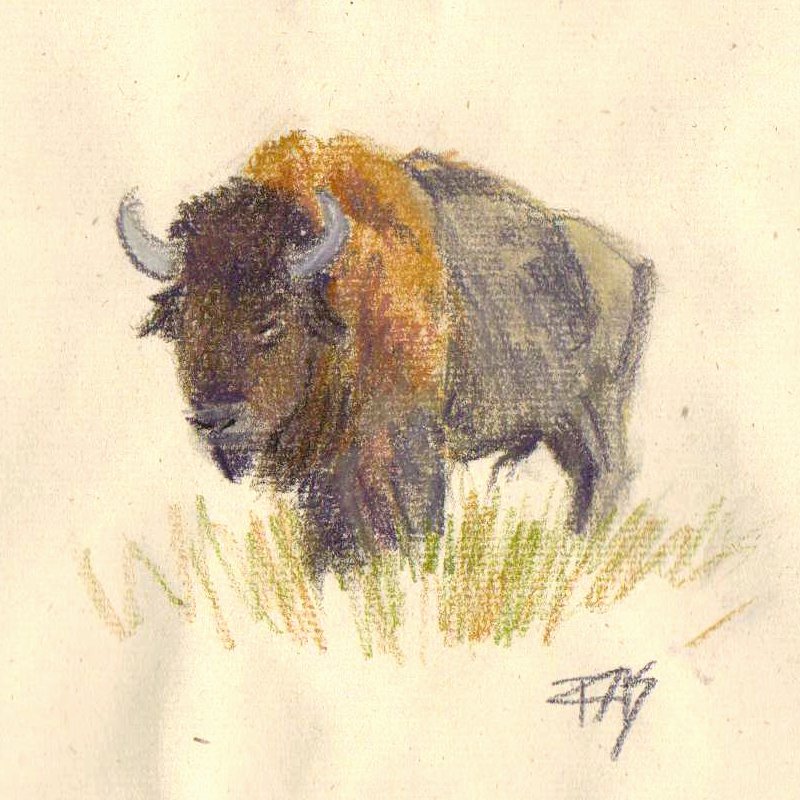
The bison doesn't have anything to do with this article. The way I drew it does. I sketched it with pastel pencils, dropping back to a style of drawing I've used with charcoal pencils or pastel pencils or colored pencils all my life. It's an animal, a subject I've had more practice with than any other. The only easier animal would've been a cat. It came out well because I'm so used to animal anatomy and pencil sketching that it would've been very hard to mess it up.

My results trying to draw that bison in Sketchbook Mobile would not be as effective. Let's give that a try. I have my phone right here.


Better than I thought. At least you can tell it's a cartoon buffalo. I finger painted that with a medium I've barely started to use, one that has no tactile feedback. My finger slides over glass and I can't actually tell which point on the pad of my finger creates the line. It's not on a par with the cool one I did in pastel pencils.

Don't change what works.

It's okay to experiment, try different things. I'm not saying not to experiment. Just know when to abandon a failed trial. Sketchbook Mobile wasn't a failed trial. At least I got a cartoon out of it and with enough practice, I may be able to get something that looks like a pen drawing.

My worst, most painful year in Nanowrimo started with a failed trial. I had the ambitious idea that I could both write and edit my novel in November. This would've been fine if I'd started off by writing the book and didn't look down till I got those two magic words: The End.

What works is to make little edit notes in the synopsis and keep writing as if the changes were made. Typing "I'll probably have to cut that drippy foreword" doesn't break my process.

Going over it again at the end of every chapter for a slow careful line edit does. Worrying about the beauty of each sentence and whether I've used any unnecessary words does not win Nanowrimo. Letting out the Inner Editor and Inner Creator at exactly the same time, while also painting and drawing, led to a train wreck.

It let in the side of my mind that isn't supposed to be involved in writing at all. The Inner Censor. The social censor, the worrier that constantly weighs who might or might not be hurt or offended by this or that in the story. That turns the creative process into a democracy - and the only thing that creates is literary oatmeal. Nothing can ever be bland enough to satisfy the Inner Censor.

Best thing to do is keep your head down and don't write at all.

So many of those voices of the past kept telling me not to be a writer at all. Both parents. All four grandparents. Most teachers including English teachers. Almost all ex lovers including the one that was a thirteen year marriage in all but legality. "If you ever got published, I couldn't stand it. You'd be insufferable. I'll leave you if you ever get published."

Well, truth be told, that ex already left me over a decade and a half ago. Since when is the risk of losing a relationship I don't have a good reason not to finish a novel?

These things aren't rational. Time does not exist for the Inner Censor. At least one nun whom I know to be dead would be angry and debate me into the ground about what I'm doing in this novel, the themes and ideas within it. She'd have found ways within my own ethics to challenge me about why I'm writing it and why I'm writing it the way I am and every bit of content in it. Heck, she isn't even the worst, though I do sometimes compare her to Gaius Helen Mohiam from Dune. At least with her, she only wanted to get me to question it, not necessarily back down. Just know where my integrity stands and why.

I'm writing about the Inner Censor because philosophical nuns, disapproving family members, friends and romantic partners are not just my problem. They happen to almost every writer. Heck, Version B happens to those rare and lucky few writers who got labeled as Talented when they were toddlers, surrounded by grownups who were excited to have a writer in the family and encouraged every time they picked up a pencil or got an idea.

Let's call that lucky writer John-Boy. You remember The Waltons? I hated that narrator. I admired him, because a lot of his voice-overs came from good books the series was based on and they were good writing. John-Boy, obviously an authorial self portrait, was a darn good writer. What I hated him for was that every single person in his school and family took it for granted that he was a writer.

They didn't treat him special for it or exempt him from chores. They just took it for granted as his strength, like the tall kid was the tall kid or the good cook was the good cook. The family was nauseatingly, unrealistically nice to each other. Or maybe out there in the world, families existed where people didn't turn around and take out everything bad that happened, ever, on their nearest and dearest, seeking to cripple them emotionally and keep them dependent. There are such things as happy families.

There are even more middling ones with bad days and good days. It's not like the show lacked conflict.

I look back at John-Boy today and stop to think, maybe the original author of the novels didn't get that benign acceptance of his goals. Maybe he got kicked in the teeth as often as I did, as often as any of us do. Maybe he slipped in John-Boy's golden happy emotional situation regarding writing as a wish fulfillment - one little thing that wouldn't distract from the real struggles against poverty and the risky hard life of a farming family that was better than real. Maybe John-Boy was a discreet Mary Sue, kept under the radar because he had a real function in the story.

For all I know, in the place and time the story was based on, the minister sermonized against frivolities like wasting time reading novels or worse, writing them. Scrutinized fiction as one of those vanities that shouldn't be encouraged. Maybe the author did hear "Nobody makes a living writing books" and "Quit wasting your time with that, you lazy bum, there's real work that needs to be done" and all the rest of the poisonous canon.

Someone with a supportive family can be armored against it, cushioned against it. That bears its own risks. What happens when they adored your heartfelt nature stories and hung on every word... and the thing inside every creative person rears its individual head to send the writer plunging into the abyss of Lovecraftian horror? "John-Boy, this isn't like your other stories. It's creepy. I don't like it, it gives me the shivers. I wanted the little boy to live. Why'd you kill him? I'll never get to sleep tonight. Ugh! Don't do anything like this again!"

That's the side that'll slap even those whose writing is approved and loved. Everyone's got an opinion. It would take more than just loving your writer child to reach a level of acceptance that allows the writer child to turn in the Green Lantern knockoff instead of the beautiful literary accomplishment you expected. Or a soppy romance. Or a cheesy horror story. Anything that's in the genre the parents/friends/partners got used to and loved is at risk.

I worked on "Trouble in the City," my second Magical Cats book, which turned cool and started developing echoes of Armistead Maupin because I wrote it in San Francisco and the setting is a big part of magical cats books. It was coming out well. Even the Inner Editor was humming along polishing what looked like good rough prose before the line edit. Plot moving along at a gorgeous pace, leaping from scene to scene as lithe as a - well, as a cat, really. I had my own cat Ari coming up on my lap to shed Cat Hairs of Inspiration and talk to me about it in his little high kitten voice.

It got harder to work on at every session. It was coming out well. Going back to it at all was like pulling teeth. I had panic attacks. Flashbacks to my childhood. Grinding hours and days of writer's block. I finally got fed up when I procrastinated about six days in a row and ate up all my Virtual Days. I fell behind twice.

I finally understood what's wrong.

If it ain't broke, don't fix it. My method is to write the rough draft first, accepting it with the unequivocal joy of a new kitten. I can make notes or fix typos as I go, part of the rhythm, but I don't question that the point of this draft is just to find out what happens in the story. Even when I edited this year's Three Day Novel, I didn't start editing till after I'd reached the end and the draft was complete.

Mixing those processes let in the Inner Censor again. At the same time I was working on getting my Street Artist License, going through the last round of necessary hurdles, going out, cashing Google checks, going here and there to offices, coming home too tired to create anything. Losing days to getting sick because I do earn my check for that day job of Being A Cripple. Any physical activity is going to cost me a lot more in time, pain and body energy than writing books.

It got to be too much. I couldn't keep up. I was living in the same physical state as I did when I was a little kid with undiagnosed congenital deformities trying to keep up with everything children are expected to do. The horrors crept in.

I broke out of it with something crazy. I set aside "Trouble in the City" and started another novel. I remembered that only a couple of months ago, I wrote a novel over 50,000 words over a three day weekend. Maybe starting over, from scratch, would get my method back on track and I could save the magical cats book by writing a new one first. It's not like I haven't done more than one book some Novembers.

I gave up on the editing goal. I formally renounced it in the Nanowrimo forums. Let go of it and told the tale, just as I'm telling it in this blog. Like learning the Dvorak keyboard, November is not the best time for dangerous experiments. Do what works for you.

Forget about anything that has a steep learning curve until you've mastered that new thing to the level you can just do what you want with it.

I'm sure by next year, when Sketchbook Mobile has been my doodle pad for over a year, I'll be happily doing quick animal studies in it with or without a stylus. It'll be as familiar as pastel pencils are now. Or the year after. At some point it won't be the difficult new thing, it'll be one of the many familiar well-used tools in my creative workbench. I'll be giving myself a stretch in some other direction. It could be materials or technique or subjects. I'll know when I get there.

Start to learn the Dvorak keyboard in December and next year's Nanowrimo will go better than ever. Your hands will hurt less and your word count will be at least as good. Two years after, your word counts will astonish you because you're typing faster and easier. I can honestly say the Dvorak keyboard layout doubled my output.

Just don't start it on November 1st.

I may someday be able to keep a rhythm of "Write when I get up, clean it up in the second session that day." There were days it went well. Not till I'm used to it, so used to both the process of editing and that schedule that it's as familiar as Dvorak is now. Until then, I'm better off writing by the seat of my pants.

I've also got to consider that I might never really get it, any more than I find outlines useful. When I've got a good method that churns out readable very long stories every time I sit down to do it, trying to switch to someone else's doesn't necessarily improve them or my production. I did use a full outline method once. The book was no worse than my other books but no better.

I just didn't enjoy writing it as much and didn't get that happy immersion I'm used to. It felt like work every step of the way. That's what this was like. Instead of spending my time with the cats and tarot readers happily ignoring my money worries, I wound up putting my nose to the grindstone and working hard every time I sat down to it. Any distraction looked better. I preferred watching television. For me that's a biggie. I'm not much into TV.

By the deepest part of the block I couldn't even draw either. That's how far my creative side shut down. There are some things in this world that you can't do just by dragging yourself to work no matter how you feel. That's effective in office work, factory work, maybe even physical work as long as the skills are reflex. You can do things on automatic.

Writing novels is not one of those things.

So when I started from scratch, the best direction I could take turned into another leap. From childhood I always wanted to write Horror. I loved Poe. I loved Kafka, a novelist who might be the hard core China White heroin of the horror genre - so terrifying that it makes chainsaw massacres, living dolls and zombie apocalypse look like a playground romp. Kafka can make you depressed.

Kafka can also pull you through depression if life is that depressing yet you recognize that Franz Kafka knew how bad it could get. That he had those feelings. That he either was or knew people who felt as bad as you did.

So I was depressed, I was scared, I was getting panic attacks and that part of me that writes stories started giggling. "It's a wonderful nightmare. Jump right in and write it!" Off I went with a ten year old protagonist. I even made him a writer character, though I toned down the conflict about his writing by tossing in other, bigger conflicts. The evil pedophile priest is someone I grabbed from the news. There have been a lot of them making the news, not just recently but as far back as I can remember.

He had to be larger than life. So I brought in things larger than my life and then tossed in the supernatural. It's got an echo of The Evil Seed classic story too - the one where innocent little children wind up unspeakable monsters because they gain power over adults and have no judgment at all. I made them time twins. I set them loose, a good twin and an evil twin, both of them sketchy self portraits.

The bad boy is who I'd have been if I'd done every mean thing I wanted to growing up in pain. The good boy is closer to who I actually was, though he's given me a few surprises due to changes. As usual, the I-Guy, both of them, stopped being me as soon as they hit the page. I left out the birth defects, that's a biggie. They're just small and puny, undernourished.

It's a book I would have devoured at ten. At ten, I wouldn't have cared how it came out. I would - I'd have been as passionately engaged as I am. But I would also have happily accepted a dark ending. If both boys got destroyed and damned with their souls sucked out through their nostrils by the end of the book, it would have been okay as long as it was the right ending. If the bad twin killed the good twin and strolled away laughing to start a series, that would've been okay too.

Anything can happen. The safety net is gone. I stick to happy endings most of the time even if some of them can be described as "Whew, at least we survived the book." I'm not Kafka and there's a streak of Bradbury sweetness that comes in too.

It hasn't ended yet. I have another 12,500 words or so to the end and that's if it's exactly 50,000 words, which I doubt. I think it'll weigh in at about 50-60k. It doesn't have to be a long Horror novel. It just is one, the farther I get into it, the more horrific. Some ugly things are going to happen in the next chapter and the Good Twin has just been good in a tragic way - his strengths are his weaknesses. He saved the Bad Twin a couple of chapters ago.

If there are deaths from the Bad Twin, he's going to see the blood on his hands. Provided he lives, right now he's in the hospital with an injury caused by using the healing magic. I don't know what'll happen. I'll find out when I open the file for Chapter 15 and start writing it down.

When it's done, when I write The End on it, I'll open up all the chapters of the magical cats book again and finish it. This is like a purge. I'm back in the rhythm of writing the way I know how and it'll be as easy to pick up Trouble again as it is to pick up The Hunger Games again at the end of a 16k day and enjoy another dark book that keeps me in the dark gritty mood.

Tip: reading a novel that has nothing to do with your concept and may not be the same genre, but shares a mood with it, may help fill the well. It can also give the rough prose a little more polish, if it's a good one. Just like looking at Old Masters in the museum helps me paint my own impressionist landscapes better, reading good novels will kick up the quality of my prose.

Look for unexpected bestsellers, books that broke out of their genre. Look for the ones that become a compelling reread instead of something that was a cool fad during its day in the sun but forgettable later. Some favorites that keep me on form: Silence of the Lambs. Harry Potter books. Stephen King's masterwork, the Dark Tower series, plus the expanded version of The Stand and of course, Misery.

I'm happy to say The Hunger Games just got onto that short list. I bought the trilogy on sale because everyone was talking about it and it was cheap. There's a reason it became that big a hit, the author never lets up. The protagonist may be a teenage girl but she is not shallow, she is not normative, she isn't boring and she sure isn't weak. I like a strong protagonist. I like to meet characters who stand up to hard lives at least as well as I do. I tend to take heart from that.

I don't know which, if either of my boys will live through this book. It doesn't matter as long as the story comes out right. I went over to the dark side and I'm writing the stuff that kept me sane when I was a scared little kid with too many real things to cry about no matter who said I was crying over nothing.

The only way to regain myself was to face that pain.

Writing is a dangerous profession. We go up on the tightwire of the mind. We reach deep into our own souls for the stories that reach other people. It doesn't matter who I am or where I learned about pain and fear. It's there for everyone. Pain Level Ten is the worst you've ever had. That's its literal definition in the pain clinics.

No matter who you are, there is a Pain Level Ten. There's some unendurable moment in your past where the pain blotted out everything and you could not handle it, no matter how strong you were, nothing could break through that pain. There is always a point in every life where the pain wins.

Emotional pain level ten happens too. Some people say "what doesn't kill you makes you stronger." Not always, sometimes it just catches you up in bad weather and trips you when something you would've been able to outrun is on your tail. Some people say "You're never given any challenge beyond what you can take."

That guilt trips the victims. People get challenges in life they can't take all the time. It's cruel to single out the ones that break and talk about them as if they're unworthy to live. A lot of people do well in life because they're lucky and nothing so vast that it would break them ever impinged on them.

When I lived and worked in Chicago, a suicide jumped from a thirty story building. He was wealthy, wearing an expensive suit. His shoes, fancy ones that must have cost hundreds of dollars, flew every which way. I heard various stories about why he jumped. I saw his hand, a strong well shaped hand, sticking out from under the tarp they put on him, reaching up with long healthy fingers. He might have changed his mind on the way down.

One of the stories was that his father in law was angry with him and they had a fight on the phone. Another was that he'd just heard that he lost his job. Another was that he lost a parent. People break over different things. I think about him sometimes, envied by so many people, lucky all his life until the day whatever was more than he could face drove him out that top-story window.

Life's what it is. We read stories and tell them to make sense of it, to understand the world around us, know what the risks are. We turn to escape fiction to set it aside for a while and then to look at it from a different angle. Maybe come up with something inside that makes it possible to keep going. Or more, to keep going and be the kind of person who'd split a piece of bread in Auschwitz.

So in those moments when you think you're not good enough, remember that no one else is either. Think about the characters you love who wouldn't exist if you don't finish the book and get it out to your readers. More than that, think about your core reader. The one who's going to be reading it on the bus and have a little more resilience, a little more heart, a better chance not to do something stupid when it gets too hard out there.

They were there for me, all those writers of my childhood, living and dead. Bradbury. Ellison. Kafka. Poe. King and Rowling. I have to add to the stream. I can't just sit by and do nothing, it's my job to pick it up and do my share of it.

Monday, November 7, 2011

How to Handle Interruptions


The above is a pastel challenge painting for the November "Pastel Spotlight" at WetCanvas.com. I've been participating in the Spotlight Challenge every month for a long time now. It's got nothing to do with Nanowrimo or my fiction writing, except that I'll occasionally do an illustration or get a good idea from a Spotlight painting for a plot point or a setting.

I'm seven days in on my 2011 Nanovel, "Trouble in the City." I also had to go out to get my city tax registration done, my state tax registration done, get a doctor's appointment to approve a rollator because my cane is not enough (the gadget is something like a walker with wheels that has a fold-down seat.) In between I had some other outing that was necessary. Three days in a row of going out when my residential hotel's elevator is broken.

If I didn't mention it in previous posts, I have some serious mobility problems. I am that guy who can walk but not too far. I really need a power chair, but can't get one till I move. So while going out for most people is a minor interruption they face every day, for me it's massive exertion resulting in major pain and exhaustion.

I got all three of those "outing" days taken care of. The day after the third necessary outing, my body quit. I was planning to work on a pastel cat commission and then work on my novel. Bang. I wound up so groggy I started to pass out as soon as the maximum dose of pain medication knocked the pain out far enough that I could sleep. That was Thursday after the excursion. No writing. Friday, I slept like my cat, about 20 hours. Still no writing.

Uh oh.

48 hours of gap between novel writing sessions is too long to stay immersed, especially when other immersive activities happen in between. I have Art Mode and Writing Mode. When I'm thinking about painting, my mind becomes wordless and visual. I play with color. I see everything in pastel impressionism. Of course I did a good job on the pumpkin. I don't even remember which night I did it. Only that it was the last concentrated activity I did before I completely crashed on exhaustion.

Painting and writing are both sit still, mental energy activities. Especially at that size of painting. It's only 5" x 7" so it was a good reason to sit still and not go running around the room like mad in an excess of adrenaline. But it was an attractive distraction when it came to working on my novel.

For you it could be something else. A kid getting sick or needing homework help. Something happens at work, a crisis that demands total concentration. A marital or relationship fight in which your well-being and even a good chunk of your identity rests on sorting out whatever it is that bugged your partner or that your partner is doing to bug you. Like interfering with your novel.

You wind up spending a lot of concentrated time and effort on that important something else and then when it's time to work on your book, it's a blank. You can't remember who the characters are or why you care about them. You're stuck. Nothing about the book makes sense. All momentum is gone, it's like starting over. But worse, because you'd have to chuck so much good rough draft that you've already written.

I developed a system to handle it. This is easier the closer to the beginning of the month it happens.

Read through your novel again from page one.

That is the only cure I know of for a Total Break in momentum. When I just can't remember anything about what I wrote, I've got to reread what I wrote. Sometimes later in the book or if it's a minor interruption, just reading back one chapter or a scene is enough to remember what it's about, what's going on and what needs to come next. But if it's a bad one, like over 48 hours without working on it or thinking about it, I usually have to go back all the way to the beginning.

That can take time, especially in a long novel toward the end. Sometimes I'll read and skim, just glancing over pages, skipping chunks, picking up enough to get the drift and remind myself why I love it. But do at least skim the whole book if the interruption was bad enough that you can't remember what it's about or why you wanted to write it.

The lesser version - read back a few pages - that's good for the start of a writing session. If you're stuck at the top of the day's writing, just read back a little to remember where you are and keep going when you get to the part that's not written. It's not just good for major interruptions but for minor ones.

If your dog barked and did the potty dance in the middle of your writing time, read back a few paragraphs when you get its walkies done and come back in. Keep going when you get to the part there's no more story.

If you come to a grinding halt because you're pantsing and don't know what comes next, it's one of the ways to steer past that kind of break too. Reading again from the beginning or skimming can give back your full momentum. It can also reveal little casual details you threw in for fun early on that you can hang later conflicts on.

Oh wow. Brian hasn't told Gina, his new heart-throb, that he is not a Believer in anything. He's a total materialist skeptic. But she's the girl of his dreams. But she seems to be a True Believer in anything and everything, it wouldn't surprise me if the gal also got into cryptozoology and aliens. Yes! I see some trouble ahead for the happy couple. Load that conflict into my plans for the rest of the book and pull it when it'd most inconvenience them both.

My villain is gloating over that one, it's a way he can steer past this new flame to go back to abusing and bullying the girl. He's a garden variety occultist jerk that I loaded with some real power within the novel's universe. Scary yet nightmarishly realistic - anyone who's ever gone to a psychic get together has met someone like this guy and tried to edge away, or been taken in and given him way too much money, emotion and attention.

Whatever you're writing, even in this rough stage, your story has a power of its own. It has momentum. It's going somewhere. You may not always be able to tell where - but it's like picking up a half-read book if you let it sit for too long and forgot what it was about. Just go back a bit and you'll get your balance again.

That's this week's Nanowrimo tip.

The other big point of today's story about my 2011 experience is this important one.

Do not let setbacks stop you.

This is why I put in more time on the first few days to try to get ahead. I gained three "Virtual Days" before I had to use two of them because my body quit on me. That strong start meant I didn't even fall behind. I still had one Virtual Day to go before I was dead even with the Nanowrimo pace.

If you do fall behind, don't sweat it. Schedule in some more hours. Take the time to read back and get back into the story, then write forward for a longer session. If you don't manage that but do get some words in, count that as progress. Always pat yourself on the back for any progress.

Don't bother beating yourself up for setbacks. It does no good and won't motivate you. What works best to deal with setbacks is to just accept them and then do some more, push hard and get ahead again. It's much easier to keep going when you get ahead. If you haven't bought yourself a "Cushion" yet by writing a bit more than the day's words, try it today.

Just double your writing session. Stick with it while it's fun and exciting, follow your characters on their tangents and don't let the surprises throw you for a loop. I was not expecting my characters both to get Love At First Sight and know it. Usually romantic subplots involve unconscious attraction and plenty of reasons on both sides for the lovers to deny it and pretend it's not happening or not that serious.

Instead, Gina took matters into her hands and delivered a passionate first kiss within twenty minutes of meeting the man of her dreams. Wow. He was stunned and swept off his feet and they went from zero to tango within a scene, so fast that even the villain's interruption didn't shatter that lovestruck moment. I love that crazy roller coaster of a chapter. Bang, heroine, best friend and villain all showed up at the same time and slammed right into the first romantic conflict as the villain unsuccessfully tried to tell the lovers that he was Gina's boyfriend, not just her stalker. It doesn't get better than that.

From here it can only get more tangled. Love at first sight has an inherent flaw - you really do not know that person at all. You love them without understanding anything about them or their past or their habits or their beliefs. You could be a night owl hooked up with an early bird who will not let you sleep a full day again in your life. You could be a neat freak meeting a woman who qualifies for a "Hoarders" episode and yet that powerful emotion leads you to just smile and clean up after her despite her objections.

There's plenty of conflict in Love At First Sight.

So when the characters blind side you, play it as it lays. Drop previous plans and look for the conflicts inherent in what just happened. They're there, no matter what it is. The highs are always followed by the swoops in the plotline roller coaster!

Have fun with your book. No matter what happens to interrupt it, when you skim back over what you have you'll know you're still on track for a November win and a great read. After all, you're doing this your way and it's exactly your flavor of story. Like cooking for yourself, you can't go wrong if you get it to taste good to you! Lots of other readers share your tastes, more than you'd believe.

So enjoy it and keep on going! Write on!