Oh boy. It's been two years since I updated this blog and it's a good one. Just to catch you up, I had some financial issues that led to some health issues and logistic problems. I live in San Francisco on a limited SSI income in an SRO - Single Room Occupancy residence hotel. I love this place and the rent is affordable. It's tight though, so rising food costs and other expenses ground me down and I had serious trouble eating till I got onto a hot meals program from the local Salvation Army. Five days a week, minus holidays, I get a good organic hot lunch from them and that closed the gap.
I also used to see a therapist every week on Mondays. From going out maybe once or twice a year in harsher climates, I went up to six times a month on necessary medical appointments with others thrown in as needed - usually by bureaucrats or doctor's demand. In my first six months I had to go to many more because of various things I was doing. I wore myself down. IT takes years to completely deplete my body energy but when I'm living on a cumulative net loss and overexerting myself, it will eventually catch up with me. I wound up shutting down more and more aspects of my life because I didn't have the energy for it. I slept like my cat.
Part of that was a change of therapist. My first one did me a lot of good and helped me like a case manager. Julie even hooked me up with the food program. However, the second one, a good therapist, relied much more on methods that don't work well with my physical disabilities. I gave it a good long try and we explored every possible solution within his skills but had to quit.
The program changed its rules so that long term therapy wasn't supported so we couldn't go on with the method that does work. Talk therapy unraveling past traumas with full understanding of their causes and scars helps and always seems to point to the same thing.
Either my physical disabilities, especially when untreated and undiagnosed, distorted my relationships or the necessary adaptations I made to be able to function at all made me very hard to live with. Many things most people enjoy are difficult or impossible. I limp to a different drummer. I'm not a loner by personality. I'm a sociable, gregarious person who enjoys being around people in any positive situation, but only when I'm physically up to socializing.
In person past a certain level of pain or loss of energy, I'm not fun to be around. I get foggy and confused. Fibromyalgia can reduce me to unintelligible so fast if I get an emotional shock. I had to give up debate in person and eventually altogether.
Now I post my views online just to air them and don't read the discussion that comes after unless some positive comment gets to my inbox. I will be one of those authors who has to pre-filter his reviews or just not read them because it's not worth getting sick over it when my book isn't to someone's eloquently expressed taste.
Crowds are right out of it. I literally can't keep up moving with the crowd. I'm not afraid if I'm up on the podium doing public speaking, because they're not running right at me. I can open up there at my pace and get entertaining. But I will not be in time if I try to sing with a chorus or be able to stay on my feet throughout the song.
I can't live on the clock. I thought I could live on the calendar but if I get sick, a long slow recovery time knocks me off that. I thought I could do deadlines. The only way that works is if I'm already done and that's just a matter of when to release it. There is no way my body will allow me to behave in a professional manner. I am not and never will be business class.
That doesn't mean I won't write or publish. It means that has to come on my schedule and I live on Indian time. It's done when it's done. When it hits print it's done and there will be no more changes unless I decide for my own reasons to make some years later.
Raven Dance is slated for a tightening rewrite, an afterword about real life inspiration and most of all the natural break into two volumes that comes when the timeline has about a year gap from the end of the previous chapter to start of the next. I just sailed into the sequel without realizing it was another book and the structures are complete. If all I did was come up with a book one title and break it, that's the kind of change that can work.
All the rest, old or new, are still unpublished and thus Not Done. I'm working on a rewrite of Chazho, which is book one of my Piarra series. It has a mountain of backstory and over thirty other volumes in that setting.
I still participate in Nanowrimo and I won again this year. For several years I've been doing stand alone books for Nanowrimo with an eye to more varied fare for readers when I start releasing all of them. I still love those, especially Sabertooth. They're cooling for rewrite and what I need to for a successful career is hone my editng process till it's as smooth and familiar as my drafting process.
One problem with this is San Francisco weather. November is one of my worst months here. The start of winter gets rainy and cold. Not snow like the rest of the culture but a bone-aching chill that sucks down my energy into pain and kicks fibromyalgia up into a huge continual flare at every pressure change. I sleep like my cat and can't concentrate in November.
So what I did last year was try a difficult genre I'd never done before - steampunk. I like Victoriana. I like some steampunk novels. The clothes and stuff are cool. I cannot figure out what I don't like about it since it's a style that lends itself to Dickens Revival! I could even tackle economic issues in it well, focusing on the echoes of the Gilded Age in our times. Yet I didn't exactly do that and the book barely got to 50k. I'm not sure if I even wrote the ending or halted in exhaustion on making it past the winner line. It needs more work and hard work to get it right.
This year I thought "Hey, why not Horror?" Wonderful title: Fear This. I picked a classic subject, Serial Killers and then my protagonist became a wonderful antihero who's basically a traditional Female Serial Killer: Vigilante... then the supernatural came in. Whoohoo! Awesome, it's genuinely going to surprise readers, it's myth gone wild, it's true to source as I can get it but breaks some ugly stereotypes. It's a good book.
I also had three to five day gaps between scenes or chapters staying on track. I got to 21,210 at a point I was supposed to be getting close to 30,000 and the freeze set in. I wasn't going to make the numbers on Fear This.
NaNoWriMo was a cakewalk most years. I've done Three Day Novel Contest officially three times and unofficially most years. I've written a 75,000 word Three Day Novel, a comedy with kids and bed monsters, that came out as a good stand alone book. That's my natural process and speed.
When I tackle a difficult subject during bad weather the result isn't guaranteed. So I realized I should just take Wrimo for what it is and write a bad book that could give me some good ideas or a workable rough draft. I dropped all the pressure that was choking me on Fear This and titled my goof-off project Pure Self Indulgent Tripe just to remind myself what Nanowrimo is for.
You don't get a good book on the first draft. You get a first draft that can become a good book once you polish it and throw out what isn't needed - in my case, sometimes that's one in three sentences to cut it to size. I write like an Impressionist painter. Get an idea, then throw it out there into a file working fast and intuitive. Try to get it down really fast while the idea is hot. Tell the story to myself first and then see how it looks when it's done.
From the first chapter's goofy reminiscing in first person to the second chapter introduction of a character from the old series - or rather from its backstory, he wasn't who he said he was - I was back on Piarra with my Byzantine royal intrigues, complex multi level plots, character driven stories and huge cast. Not all of them got on stage. Enough of them did that I now have a good idea what the characters are actually doing now rather than what they were doing in 2000 on and around Contact Earth.
Whether I retitle, rewrite and publish Tripe as its own book isn't relevant. I could easily treat the whole thing as a character study and world building exercise to get a better look at my series as a whole. But I won Nanowrimo a couple of days ago doing it and that brought back my mojo.
I have to have fun. I can't work on it like I'm trying to do a commission of something I'm not very good at yet. I can let the wordstream flow if I'm sick but only if I am so engaged in the story that I'm lost in it feeling the endorphins of process. If it's hard work, it may come out well but it has to be done more like photorealism - carefully look at this story and pick it out, get it precise, get almost perfectionist about its details to make it work.
That's not a reason not to do it. It's a reason not to do it for Nanowrimo. Wrimo is supposed to be a break, an annual vacation of the mind. Lose myself in a good book by one of my favorite authors, me. I like horror but my daughter brought up something telling about Horror and Fibromyalgia.
"Dad, if you scare yourself you're going to flare and get sick."
Duh. She made sense. So the Horror novel is now a slow back burner project. I might even outline it because writing it was so much less intuitive. It came out just as well outlining as "pantsing" so that may help me complete it. Get the gist of the plot down while I still know it, so I can pick it up later. Sketch and trust the sketch to be reasonably well balanced.
In art, sometimes I just sketch fast and layer color and work before the light changes in pastels. Sometimes I measure carefully and sketch in erasable colored pencils and do a watercolor underpainting neatly setting under layers to each area of tone and color, then layer Prismacolors 20 to 30 times to get a rich glowing realism painting achievable in no other medium. They are different processes, one fast and one slow. If I look at difficult books that way and difficult genres that way, I may succeed in those ambitious projects.
Just as long as there is no deadline for their completion, I'm good.
If you're doing Nanowrimo, don't forget to have fun. That's the moral of the story and what I learned in this year's marathon. Every year I do it, I become a better writer. If you hate the trash you wrote when you got the Winner's Certificate, stuff it in a folder to look at the idea again later or edit when you cool down and see what made it worth doing. My advice on that: don't throw it out. You don't know what your best work is until it's in print and other people say it is. You can't tell what worked or not till you master a skill consciously that you might have been using intuitively. Learning in the arts is lifelong.
What comes out best sometimes hurts most getting it down or takes the most effort because that's challenging your deepest self. Or it comes spilling out casually when you're not thinking about it because you're not choking on fear of failure or fear of success or fear of yourself.
I faced my killer instinct in Fear This and backed off to give that a slow nuanced long look. I have to look back very young to remember what it was like to think killing someone would be cool. I came a long way on nonviolence. Because I did, I looked at the cripple in the mirror at the top of Tripe and blew past that fear fast because he wasn't as ugly as the serial killer I would've been if I took the wrong turn as a child or had a slightly different brain chemistry or just sheer luck of the situation.
A good dose of something I couldn't handle made the other fear an easier leap, coming up with the No Brainer: I hate being sick and I would be very glad if I could get cured of it, especially the fibromyalgia that knocked me from Marginally Functional self employment down to Cannot Work. It may become a very nuanced look at that if I rewrite it and so I'm letting it get long to let that plotline expand, that character growth.
Truth is, a good chiropractor would do me as much good as a good therapist right now. Massage therapy works wonders and chiropracty is a Reset on my skeletal problems. It's palliative but efficient, twice a month getting that when I can afford it is likely to double my working time at everything. I grew up believing every symptom was psychological and in the last couple of good therapists came to understand how much my mind is shaped by my body.
Foods I don't like turn out to be allergies or sensitivities. Activities I hate turn out to have been real dangers or overexertion and injury every time. Even the way I feel about churches boils down to hard pews and ritual calisthenics standing and kneeling and doing things in unison - something that most human beings find spiritually uplifting causes me nothing but pain and grief. I limp to a different drummer. To be a good author I have to also get into the head of people who can get something out of church, run in marathons for fun, feel safe enough to seek thrills to break the boredom.
So I'm getting something out of Nanowrimo and if you haven't tried it, go join and find out what it is. There are other events later in the year, a summer Camp Nanowrimo is an early run that might be very good for me to catch up on difficult projects. April has a script writer thing. There's plenty of ways to participate. If you are doing it, no matter what you got is more writing and more practice than you had. If ou didn't finish your novel you still have some days to do more of it or finish, if you don't win you migt finish later - or just be one step closer to finishing with that much more practice to make you better next year.
It took 20 years to finish Raven Dance's rough draft. After I finished a much shorter comedy I did on the spur of the moment, I was able to go back and finish it right despite terrors it was the worst thing I'd ever created. The highs and lows were both true. It was the best thing I'd ever done. It was also the worst thing I'd ever done, for the same reason, it was the first big novel I ever wrote even if the little quickie hit The End faster.
I'll stop here because I'd go on into technical advice about pantsing, how to write rough drafts fast and easily without looking down. That's an article in its own right and a good topic for my next essay. Thanks for your patience. I'm back now on my feet or at least my wheels and ready to type.
Showing posts with label horror writing. Show all posts
Showing posts with label horror writing. Show all posts
Tuesday, November 25, 2014

Monday, November 21, 2011
Don't change what works!
This has been the toughest Nanowrimo that I've faced since 2002. That was the year that I moved out of state at the end of October and caught pneumonia. I didn't even start till November 25th. When I did, I still got up to 25,000 by the end of the month. It frustrated me no end to have a year without a win on my profile.
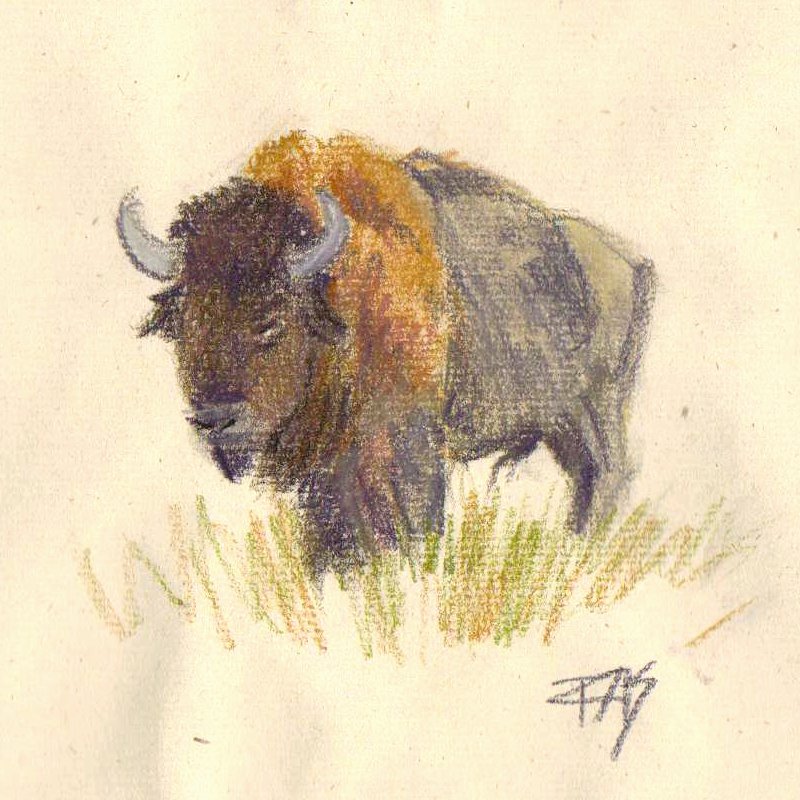
The bison doesn't have anything to do with this article. The way I drew it does. I sketched it with pastel pencils, dropping back to a style of drawing I've used with charcoal pencils or pastel pencils or colored pencils all my life. It's an animal, a subject I've had more practice with than any other. The only easier animal would've been a cat. It came out well because I'm so used to animal anatomy and pencil sketching that it would've been very hard to mess it up.
My results trying to draw that bison in Sketchbook Mobile would not be as effective. Let's give that a try. I have my phone right here.

Better than I thought. At least you can tell it's a cartoon buffalo. I finger painted that with a medium I've barely started to use, one that has no tactile feedback. My finger slides over glass and I can't actually tell which point on the pad of my finger creates the line. It's not on a par with the cool one I did in pastel pencils.
Don't change what works.
It's okay to experiment, try different things. I'm not saying not to experiment. Just know when to abandon a failed trial. Sketchbook Mobile wasn't a failed trial. At least I got a cartoon out of it and with enough practice, I may be able to get something that looks like a pen drawing.
My worst, most painful year in Nanowrimo started with a failed trial. I had the ambitious idea that I could both write and edit my novel in November. This would've been fine if I'd started off by writing the book and didn't look down till I got those two magic words: The End.
What works is to make little edit notes in the synopsis and keep writing as if the changes were made. Typing "I'll probably have to cut that drippy foreword" doesn't break my process.
Going over it again at the end of every chapter for a slow careful line edit does. Worrying about the beauty of each sentence and whether I've used any unnecessary words does not win Nanowrimo. Letting out the Inner Editor and Inner Creator at exactly the same time, while also painting and drawing, led to a train wreck.
It let in the side of my mind that isn't supposed to be involved in writing at all. The Inner Censor. The social censor, the worrier that constantly weighs who might or might not be hurt or offended by this or that in the story. That turns the creative process into a democracy - and the only thing that creates is literary oatmeal. Nothing can ever be bland enough to satisfy the Inner Censor.
Best thing to do is keep your head down and don't write at all.
So many of those voices of the past kept telling me not to be a writer at all. Both parents. All four grandparents. Most teachers including English teachers. Almost all ex lovers including the one that was a thirteen year marriage in all but legality. "If you ever got published, I couldn't stand it. You'd be insufferable. I'll leave you if you ever get published."
Well, truth be told, that ex already left me over a decade and a half ago. Since when is the risk of losing a relationship I don't have a good reason not to finish a novel?
These things aren't rational. Time does not exist for the Inner Censor. At least one nun whom I know to be dead would be angry and debate me into the ground about what I'm doing in this novel, the themes and ideas within it. She'd have found ways within my own ethics to challenge me about why I'm writing it and why I'm writing it the way I am and every bit of content in it. Heck, she isn't even the worst, though I do sometimes compare her to Gaius Helen Mohiam from Dune. At least with her, she only wanted to get me to question it, not necessarily back down. Just know where my integrity stands and why.
I'm writing about the Inner Censor because philosophical nuns, disapproving family members, friends and romantic partners are not just my problem. They happen to almost every writer. Heck, Version B happens to those rare and lucky few writers who got labeled as Talented when they were toddlers, surrounded by grownups who were excited to have a writer in the family and encouraged every time they picked up a pencil or got an idea.
Let's call that lucky writer John-Boy. You remember The Waltons? I hated that narrator. I admired him, because a lot of his voice-overs came from good books the series was based on and they were good writing. John-Boy, obviously an authorial self portrait, was a darn good writer. What I hated him for was that every single person in his school and family took it for granted that he was a writer.
They didn't treat him special for it or exempt him from chores. They just took it for granted as his strength, like the tall kid was the tall kid or the good cook was the good cook. The family was nauseatingly, unrealistically nice to each other. Or maybe out there in the world, families existed where people didn't turn around and take out everything bad that happened, ever, on their nearest and dearest, seeking to cripple them emotionally and keep them dependent. There are such things as happy families.
There are even more middling ones with bad days and good days. It's not like the show lacked conflict.
I look back at John-Boy today and stop to think, maybe the original author of the novels didn't get that benign acceptance of his goals. Maybe he got kicked in the teeth as often as I did, as often as any of us do. Maybe he slipped in John-Boy's golden happy emotional situation regarding writing as a wish fulfillment - one little thing that wouldn't distract from the real struggles against poverty and the risky hard life of a farming family that was better than real. Maybe John-Boy was a discreet Mary Sue, kept under the radar because he had a real function in the story.
For all I know, in the place and time the story was based on, the minister sermonized against frivolities like wasting time reading novels or worse, writing them. Scrutinized fiction as one of those vanities that shouldn't be encouraged. Maybe the author did hear "Nobody makes a living writing books" and "Quit wasting your time with that, you lazy bum, there's real work that needs to be done" and all the rest of the poisonous canon.
Someone with a supportive family can be armored against it, cushioned against it. That bears its own risks. What happens when they adored your heartfelt nature stories and hung on every word... and the thing inside every creative person rears its individual head to send the writer plunging into the abyss of Lovecraftian horror? "John-Boy, this isn't like your other stories. It's creepy. I don't like it, it gives me the shivers. I wanted the little boy to live. Why'd you kill him? I'll never get to sleep tonight. Ugh! Don't do anything like this again!"
That's the side that'll slap even those whose writing is approved and loved. Everyone's got an opinion. It would take more than just loving your writer child to reach a level of acceptance that allows the writer child to turn in the Green Lantern knockoff instead of the beautiful literary accomplishment you expected. Or a soppy romance. Or a cheesy horror story. Anything that's in the genre the parents/friends/partners got used to and loved is at risk.
I worked on "Trouble in the City," my second Magical Cats book, which turned cool and started developing echoes of Armistead Maupin because I wrote it in San Francisco and the setting is a big part of magical cats books. It was coming out well. Even the Inner Editor was humming along polishing what looked like good rough prose before the line edit. Plot moving along at a gorgeous pace, leaping from scene to scene as lithe as a - well, as a cat, really. I had my own cat Ari coming up on my lap to shed Cat Hairs of Inspiration and talk to me about it in his little high kitten voice.
It got harder to work on at every session. It was coming out well. Going back to it at all was like pulling teeth. I had panic attacks. Flashbacks to my childhood. Grinding hours and days of writer's block. I finally got fed up when I procrastinated about six days in a row and ate up all my Virtual Days. I fell behind twice.
I finally understood what's wrong.
If it ain't broke, don't fix it. My method is to write the rough draft first, accepting it with the unequivocal joy of a new kitten. I can make notes or fix typos as I go, part of the rhythm, but I don't question that the point of this draft is just to find out what happens in the story. Even when I edited this year's Three Day Novel, I didn't start editing till after I'd reached the end and the draft was complete.
Mixing those processes let in the Inner Censor again. At the same time I was working on getting my Street Artist License, going through the last round of necessary hurdles, going out, cashing Google checks, going here and there to offices, coming home too tired to create anything. Losing days to getting sick because I do earn my check for that day job of Being A Cripple. Any physical activity is going to cost me a lot more in time, pain and body energy than writing books.
It got to be too much. I couldn't keep up. I was living in the same physical state as I did when I was a little kid with undiagnosed congenital deformities trying to keep up with everything children are expected to do. The horrors crept in.
I broke out of it with something crazy. I set aside "Trouble in the City" and started another novel. I remembered that only a couple of months ago, I wrote a novel over 50,000 words over a three day weekend. Maybe starting over, from scratch, would get my method back on track and I could save the magical cats book by writing a new one first. It's not like I haven't done more than one book some Novembers.
I gave up on the editing goal. I formally renounced it in the Nanowrimo forums. Let go of it and told the tale, just as I'm telling it in this blog. Like learning the Dvorak keyboard, November is not the best time for dangerous experiments. Do what works for you.
Forget about anything that has a steep learning curve until you've mastered that new thing to the level you can just do what you want with it.
I'm sure by next year, when Sketchbook Mobile has been my doodle pad for over a year, I'll be happily doing quick animal studies in it with or without a stylus. It'll be as familiar as pastel pencils are now. Or the year after. At some point it won't be the difficult new thing, it'll be one of the many familiar well-used tools in my creative workbench. I'll be giving myself a stretch in some other direction. It could be materials or technique or subjects. I'll know when I get there.
Start to learn the Dvorak keyboard in December and next year's Nanowrimo will go better than ever. Your hands will hurt less and your word count will be at least as good. Two years after, your word counts will astonish you because you're typing faster and easier. I can honestly say the Dvorak keyboard layout doubled my output.
Just don't start it on November 1st.
I may someday be able to keep a rhythm of "Write when I get up, clean it up in the second session that day." There were days it went well. Not till I'm used to it, so used to both the process of editing and that schedule that it's as familiar as Dvorak is now. Until then, I'm better off writing by the seat of my pants.
I've also got to consider that I might never really get it, any more than I find outlines useful. When I've got a good method that churns out readable very long stories every time I sit down to do it, trying to switch to someone else's doesn't necessarily improve them or my production. I did use a full outline method once. The book was no worse than my other books but no better.
I just didn't enjoy writing it as much and didn't get that happy immersion I'm used to. It felt like work every step of the way. That's what this was like. Instead of spending my time with the cats and tarot readers happily ignoring my money worries, I wound up putting my nose to the grindstone and working hard every time I sat down to it. Any distraction looked better. I preferred watching television. For me that's a biggie. I'm not much into TV.
By the deepest part of the block I couldn't even draw either. That's how far my creative side shut down. There are some things in this world that you can't do just by dragging yourself to work no matter how you feel. That's effective in office work, factory work, maybe even physical work as long as the skills are reflex. You can do things on automatic.
Writing novels is not one of those things.
So when I started from scratch, the best direction I could take turned into another leap. From childhood I always wanted to write Horror. I loved Poe. I loved Kafka, a novelist who might be the hard core China White heroin of the horror genre - so terrifying that it makes chainsaw massacres, living dolls and zombie apocalypse look like a playground romp. Kafka can make you depressed.
Kafka can also pull you through depression if life is that depressing yet you recognize that Franz Kafka knew how bad it could get. That he had those feelings. That he either was or knew people who felt as bad as you did.
So I was depressed, I was scared, I was getting panic attacks and that part of me that writes stories started giggling. "It's a wonderful nightmare. Jump right in and write it!" Off I went with a ten year old protagonist. I even made him a writer character, though I toned down the conflict about his writing by tossing in other, bigger conflicts. The evil pedophile priest is someone I grabbed from the news. There have been a lot of them making the news, not just recently but as far back as I can remember.
He had to be larger than life. So I brought in things larger than my life and then tossed in the supernatural. It's got an echo of The Evil Seed classic story too - the one where innocent little children wind up unspeakable monsters because they gain power over adults and have no judgment at all. I made them time twins. I set them loose, a good twin and an evil twin, both of them sketchy self portraits.
The bad boy is who I'd have been if I'd done every mean thing I wanted to growing up in pain. The good boy is closer to who I actually was, though he's given me a few surprises due to changes. As usual, the I-Guy, both of them, stopped being me as soon as they hit the page. I left out the birth defects, that's a biggie. They're just small and puny, undernourished.
It's a book I would have devoured at ten. At ten, I wouldn't have cared how it came out. I would - I'd have been as passionately engaged as I am. But I would also have happily accepted a dark ending. If both boys got destroyed and damned with their souls sucked out through their nostrils by the end of the book, it would have been okay as long as it was the right ending. If the bad twin killed the good twin and strolled away laughing to start a series, that would've been okay too.
Anything can happen. The safety net is gone. I stick to happy endings most of the time even if some of them can be described as "Whew, at least we survived the book." I'm not Kafka and there's a streak of Bradbury sweetness that comes in too.
It hasn't ended yet. I have another 12,500 words or so to the end and that's if it's exactly 50,000 words, which I doubt. I think it'll weigh in at about 50-60k. It doesn't have to be a long Horror novel. It just is one, the farther I get into it, the more horrific. Some ugly things are going to happen in the next chapter and the Good Twin has just been good in a tragic way - his strengths are his weaknesses. He saved the Bad Twin a couple of chapters ago.
If there are deaths from the Bad Twin, he's going to see the blood on his hands. Provided he lives, right now he's in the hospital with an injury caused by using the healing magic. I don't know what'll happen. I'll find out when I open the file for Chapter 15 and start writing it down.
When it's done, when I write The End on it, I'll open up all the chapters of the magical cats book again and finish it. This is like a purge. I'm back in the rhythm of writing the way I know how and it'll be as easy to pick up Trouble again as it is to pick up The Hunger Games again at the end of a 16k day and enjoy another dark book that keeps me in the dark gritty mood.
Tip: reading a novel that has nothing to do with your concept and may not be the same genre, but shares a mood with it, may help fill the well. It can also give the rough prose a little more polish, if it's a good one. Just like looking at Old Masters in the museum helps me paint my own impressionist landscapes better, reading good novels will kick up the quality of my prose.
Look for unexpected bestsellers, books that broke out of their genre. Look for the ones that become a compelling reread instead of something that was a cool fad during its day in the sun but forgettable later. Some favorites that keep me on form: Silence of the Lambs. Harry Potter books. Stephen King's masterwork, the Dark Tower series, plus the expanded version of The Stand and of course, Misery.
I'm happy to say The Hunger Games just got onto that short list. I bought the trilogy on sale because everyone was talking about it and it was cheap. There's a reason it became that big a hit, the author never lets up. The protagonist may be a teenage girl but she is not shallow, she is not normative, she isn't boring and she sure isn't weak. I like a strong protagonist. I like to meet characters who stand up to hard lives at least as well as I do. I tend to take heart from that.
I don't know which, if either of my boys will live through this book. It doesn't matter as long as the story comes out right. I went over to the dark side and I'm writing the stuff that kept me sane when I was a scared little kid with too many real things to cry about no matter who said I was crying over nothing.
The only way to regain myself was to face that pain.
Writing is a dangerous profession. We go up on the tightwire of the mind. We reach deep into our own souls for the stories that reach other people. It doesn't matter who I am or where I learned about pain and fear. It's there for everyone. Pain Level Ten is the worst you've ever had. That's its literal definition in the pain clinics.
No matter who you are, there is a Pain Level Ten. There's some unendurable moment in your past where the pain blotted out everything and you could not handle it, no matter how strong you were, nothing could break through that pain. There is always a point in every life where the pain wins.
Emotional pain level ten happens too. Some people say "what doesn't kill you makes you stronger." Not always, sometimes it just catches you up in bad weather and trips you when something you would've been able to outrun is on your tail. Some people say "You're never given any challenge beyond what you can take."
That guilt trips the victims. People get challenges in life they can't take all the time. It's cruel to single out the ones that break and talk about them as if they're unworthy to live. A lot of people do well in life because they're lucky and nothing so vast that it would break them ever impinged on them.
When I lived and worked in Chicago, a suicide jumped from a thirty story building. He was wealthy, wearing an expensive suit. His shoes, fancy ones that must have cost hundreds of dollars, flew every which way. I heard various stories about why he jumped. I saw his hand, a strong well shaped hand, sticking out from under the tarp they put on him, reaching up with long healthy fingers. He might have changed his mind on the way down.
One of the stories was that his father in law was angry with him and they had a fight on the phone. Another was that he'd just heard that he lost his job. Another was that he lost a parent. People break over different things. I think about him sometimes, envied by so many people, lucky all his life until the day whatever was more than he could face drove him out that top-story window.
Life's what it is. We read stories and tell them to make sense of it, to understand the world around us, know what the risks are. We turn to escape fiction to set it aside for a while and then to look at it from a different angle. Maybe come up with something inside that makes it possible to keep going. Or more, to keep going and be the kind of person who'd split a piece of bread in Auschwitz.
So in those moments when you think you're not good enough, remember that no one else is either. Think about the characters you love who wouldn't exist if you don't finish the book and get it out to your readers. More than that, think about your core reader. The one who's going to be reading it on the bus and have a little more resilience, a little more heart, a better chance not to do something stupid when it gets too hard out there.
They were there for me, all those writers of my childhood, living and dead. Bradbury. Ellison. Kafka. Poe. King and Rowling. I have to add to the stream. I can't just sit by and do nothing, it's my job to pick it up and do my share of it.
Subscribe to:
Posts (Atom)